In recent years, when speaking with business owners and leaders of professional service brands, the most common complaint I hear is: “We spent thousands on an SEO agency, and sure, a few broad keywords hit page one of Google, and traffic seems up. But… our revenue hasn’t changed at all.“
Staring at a polished performance report with a steadily climbing traffic curve leaves executives feeling empty. In the business world, traffic that doesn’t convert into revenue is just meaningless server load. This is why we must redefine SEO—shifting from the traditional model of blindly chasing traffic to a business-profit-centric approach: Lead-Gen SEO.
Why Does Most SEO End Up as Just “Vanity Metrics”?
Let me share a highly common real-world case.
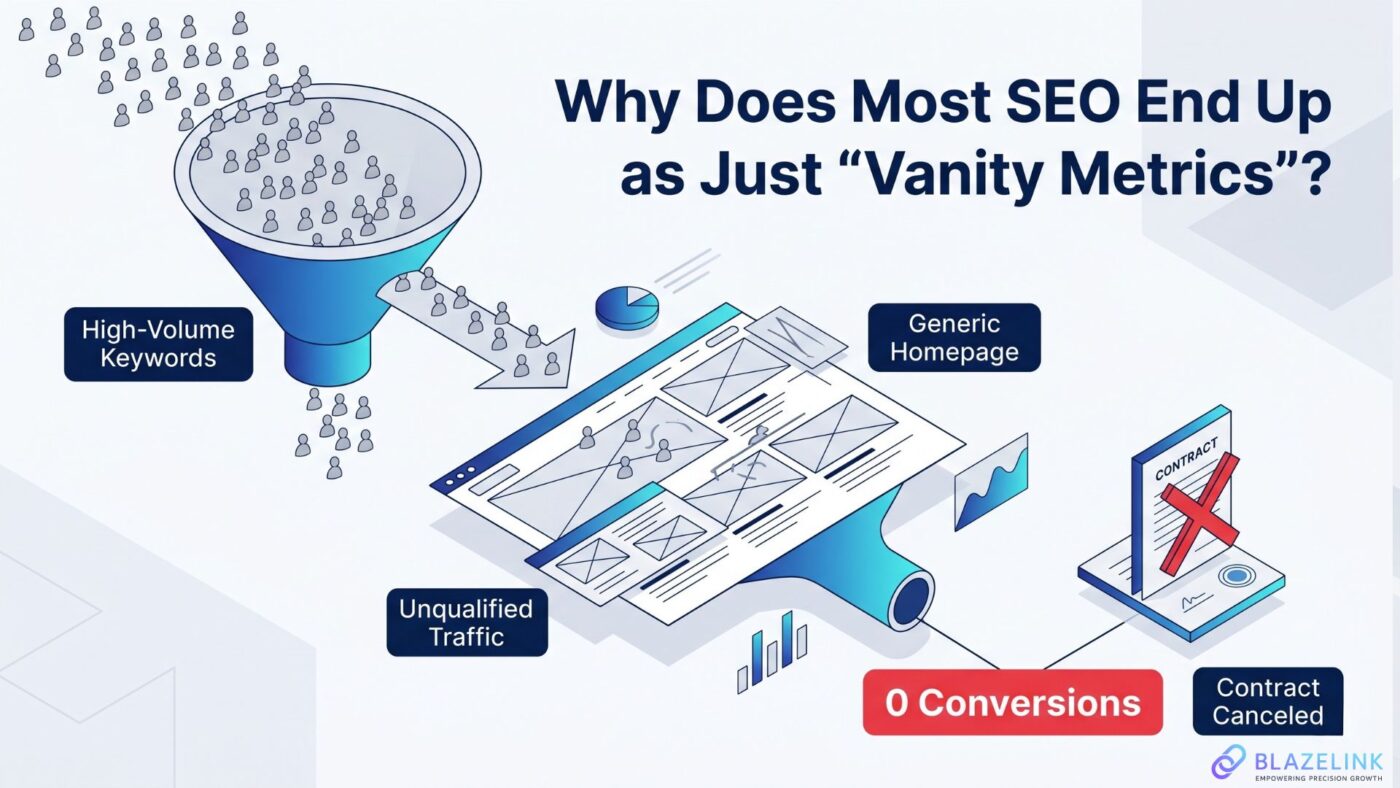
A B2B professional consulting firm outsourced its lead generation to a traditional SEO agency. The agency diligently optimized for several “high-volume keywords” and even churned out a massive amount of content-farm-style articles. Six months later, the ranking goals were met, and several keywords hit the first page.
Then, tragedy struck. The traffic attracted by these broad keywords consisted mostly of students doing research papers or passersby looking for free information. Worse, all this traffic was funneled to an unfocused homepage with no clear guidance, no pain-point messaging, and no clear way to capture contact info.
The sales team didn’t receive a single qualified inquiry. Ultimately, the contract was canceled in less than a year because the business owner saw “no tangible ROI.”
This is the fatal flaw of traditional SEO: It takes responsibility for “rankings” but not for “lead conversions.” When SEO is disconnected from the overall marketing funnel, it becomes nothing more than an expensive vanity game.
The Breakthrough: What is “Lead-Gen SEO”?
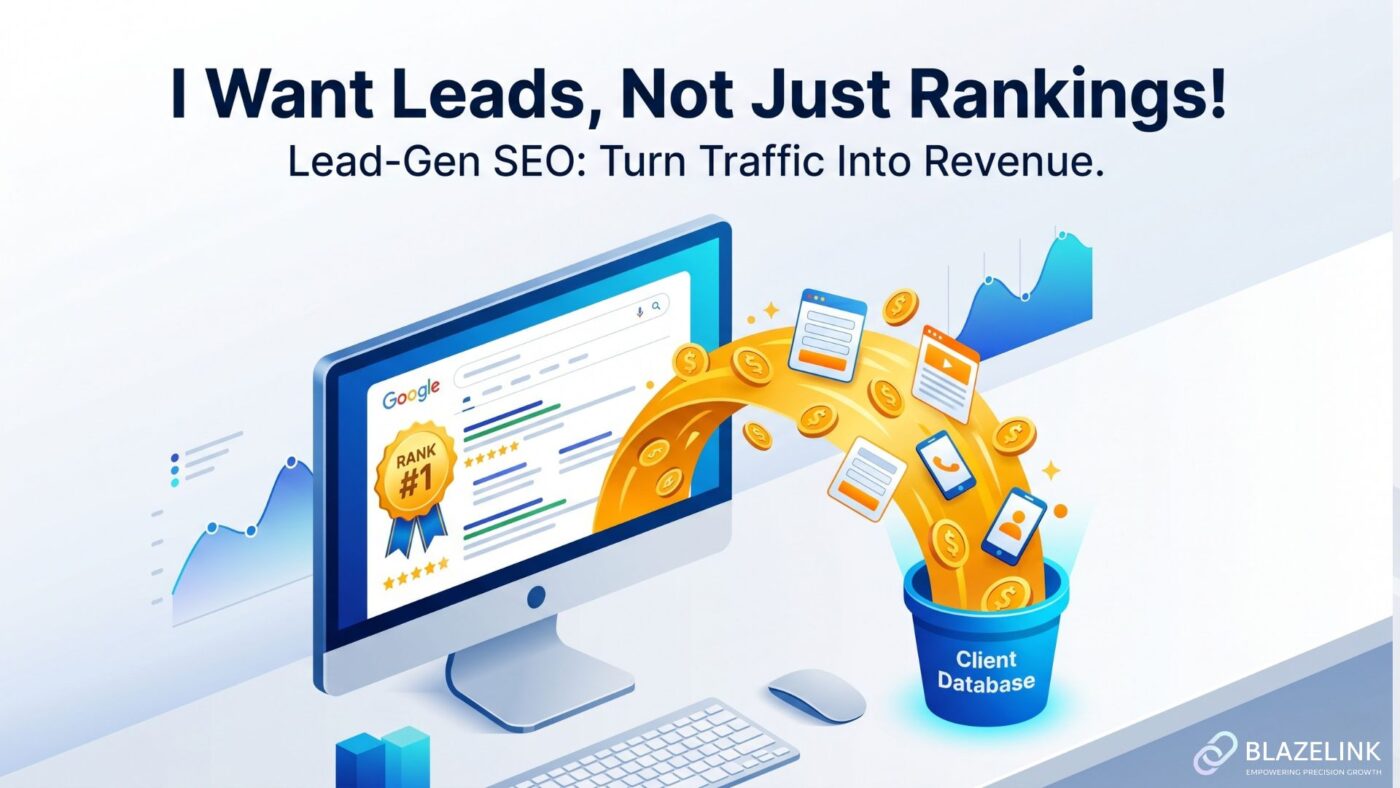
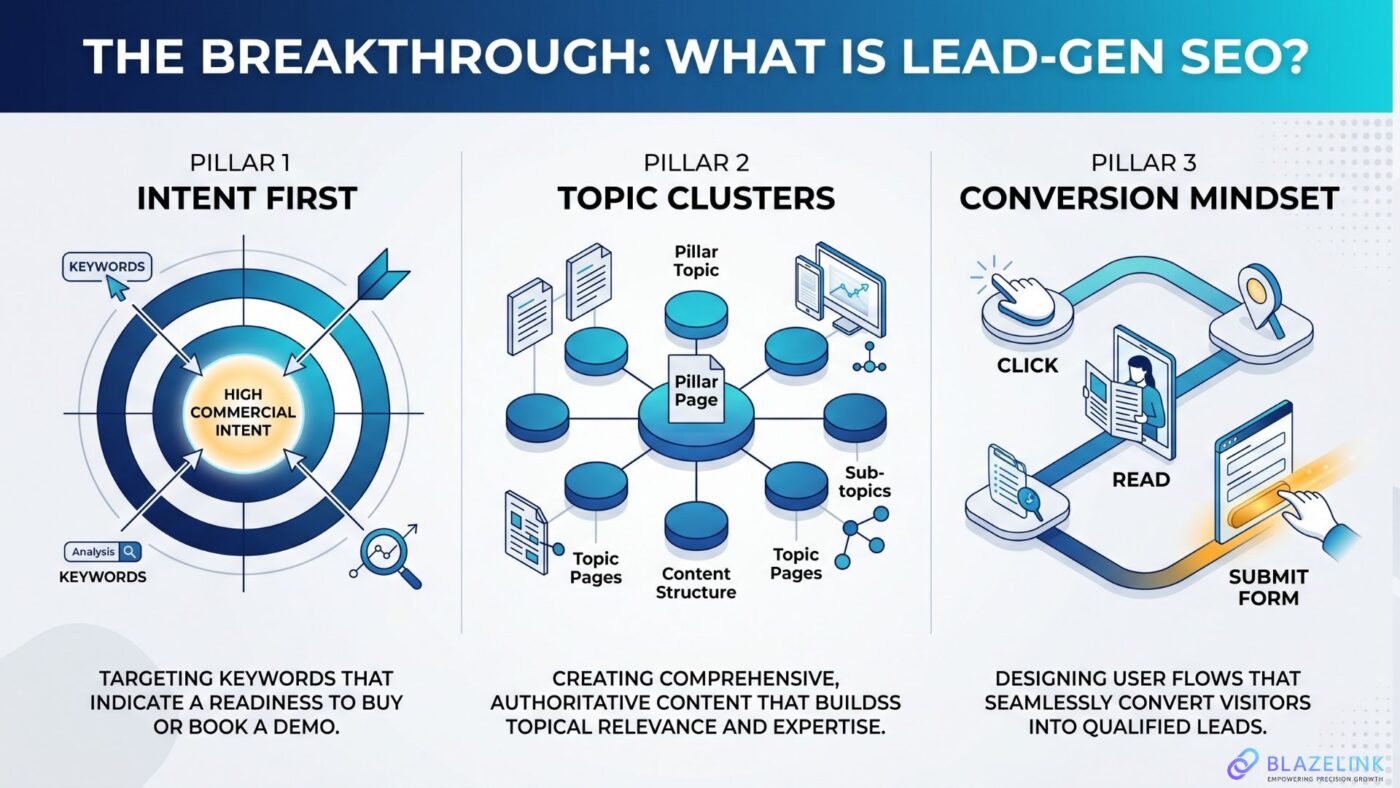
“Lead-Gen SEO” shifts the ultimate goal of SEO from “acquiring clicks” to “acquiring high-quality client leads.”
Under this framework, we no longer obsess over high-search-volume keywords with zero purchasing intent. Instead, we strategically target precise and long-tail keywords that carry high commercial intent.
Lead-Gen SEO has three core characteristics:
- Intent First: We would rather have 100 enterprise buyers actively looking for a solution than 10,000 unqualified visitors just browsing.
- Topic Clusters: Building the brand’s authority in a specific niche through a systematic content architecture, thereby earning the trust of high-value clients.
- Conversion Mindset: Every ranking and click is designed to pave the way for a final form submission, consultation, or purchase.
The Bridge Between Traffic and Deals: The Absolute Importance of Landing Pages
If you’ve implemented Lead-Gen SEO and successfully brought qualified prospects to your site, but they bounce within 3 seconds, what went wrong? The answer is usually: You lack a persuasive Landing Page.
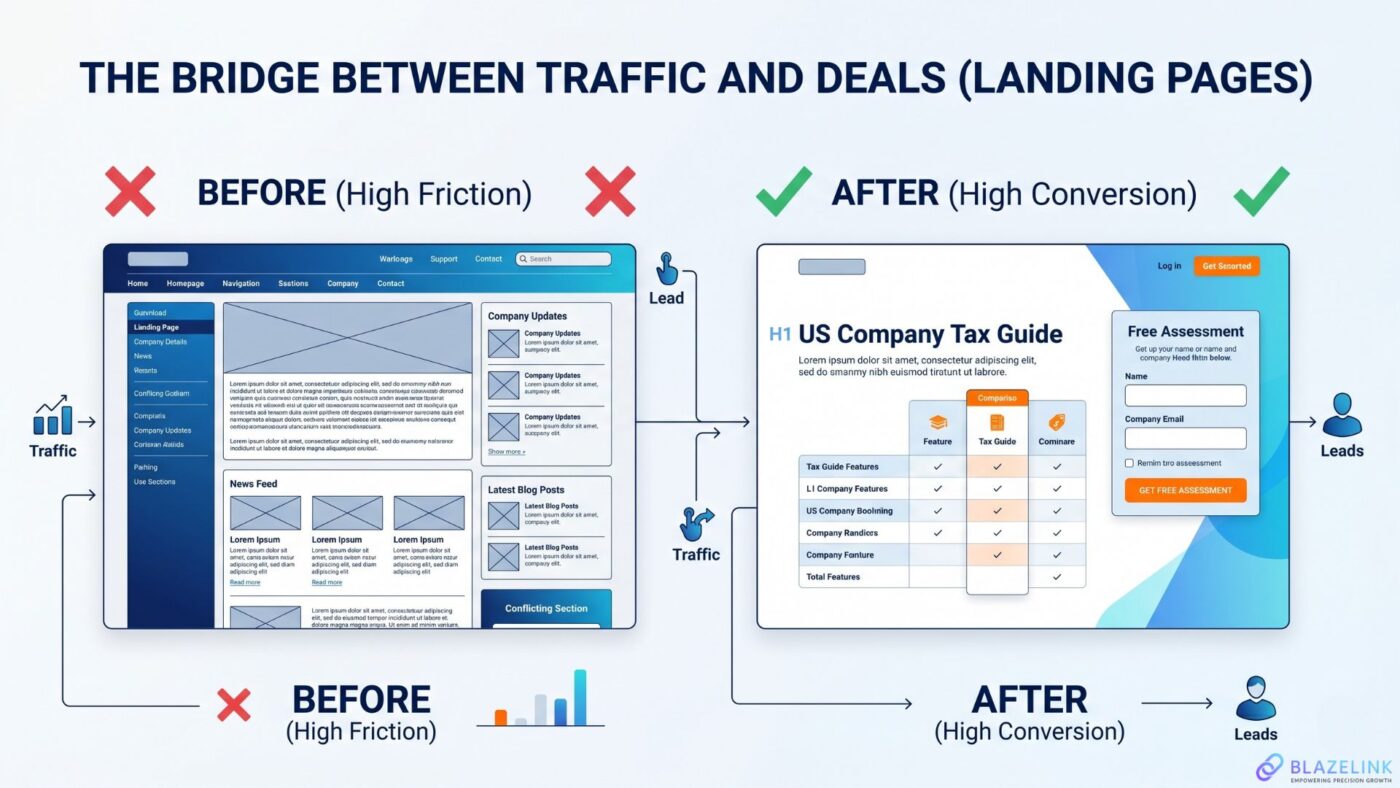
Many companies send hard-earned SEO traffic straight to a traditional Homepage or generic Services page. These pages are cluttered and lack focus. When visitors can’t immediately find the solution to their pressing pain points, they naturally bounce.
In Lead-Gen SEO, a landing page acts as your “super salesperson.” A qualified landing page must have:
- Precise Alignment with Search Intent: Visitors must immediately see the exact solution to the keyword they searched for.
- Clear Value Proposition: Tell the client directly, “What problem can we solve for you?” and “Why are we better than the rest?”
- Frictionless Call to Action (CTA): Minimize the resistance to leaving contact info through easy-to-fill forms, clear buttons, or routing to automated customer service. We can even integrate automation tools (like Zapier or Make) to trigger instant engagement messages and internal sales notifications the moment a lead enters, shortening the golden response time.
Case Study: The Conversion Gap in Professional Consulting Services
Imagine a multinational tax consulting firm ranking for the keyword “Set up a US company.”
- The Wrong Approach: Directing traffic to the official homepage. The client sees company history, an overview of all services, and the latest news. Feeling overwhelmed, they close the tab.
- The Right Approach (Lead-Gen SEO): Directing traffic to a dedicated Landing Page. The headline immediately reads “2026 Tax Guide for Setting Up a US Company.” It follows up with a “State-by-State Tax Rate Comparison Chart,” and concludes with a consultation form for a “Free Initial Tax Risk Assessment.”
The Design Thinking Behind Conversion Rate Tracking
A landing page is more than just slapping a button on a screen; it requires precise conversion tracking design. This involves mapping out both micro and macro conversions:
- Macro-conversions: Successfully submitting a form, clicking a messaging app link (like Line OA), or making a phone call.
- Micro-conversions: Scrolling past 75% of the page depth, staying on the page for over 2 minutes, or clicking to expand a specific pricing tier.
By embedding these tracking nodes, we can pinpoint exactly where clients hesitate and where they drop off, allowing us to continuously optimize the page’s persuasiveness. SEO without a high-quality landing page to catch the traffic is like spending a fortune on flyers to drive foot traffic to a store that doesn’t have a cash register.
Algorithm-Proof SEO: Insisting on White Hat Tactics and Delivering Real Value
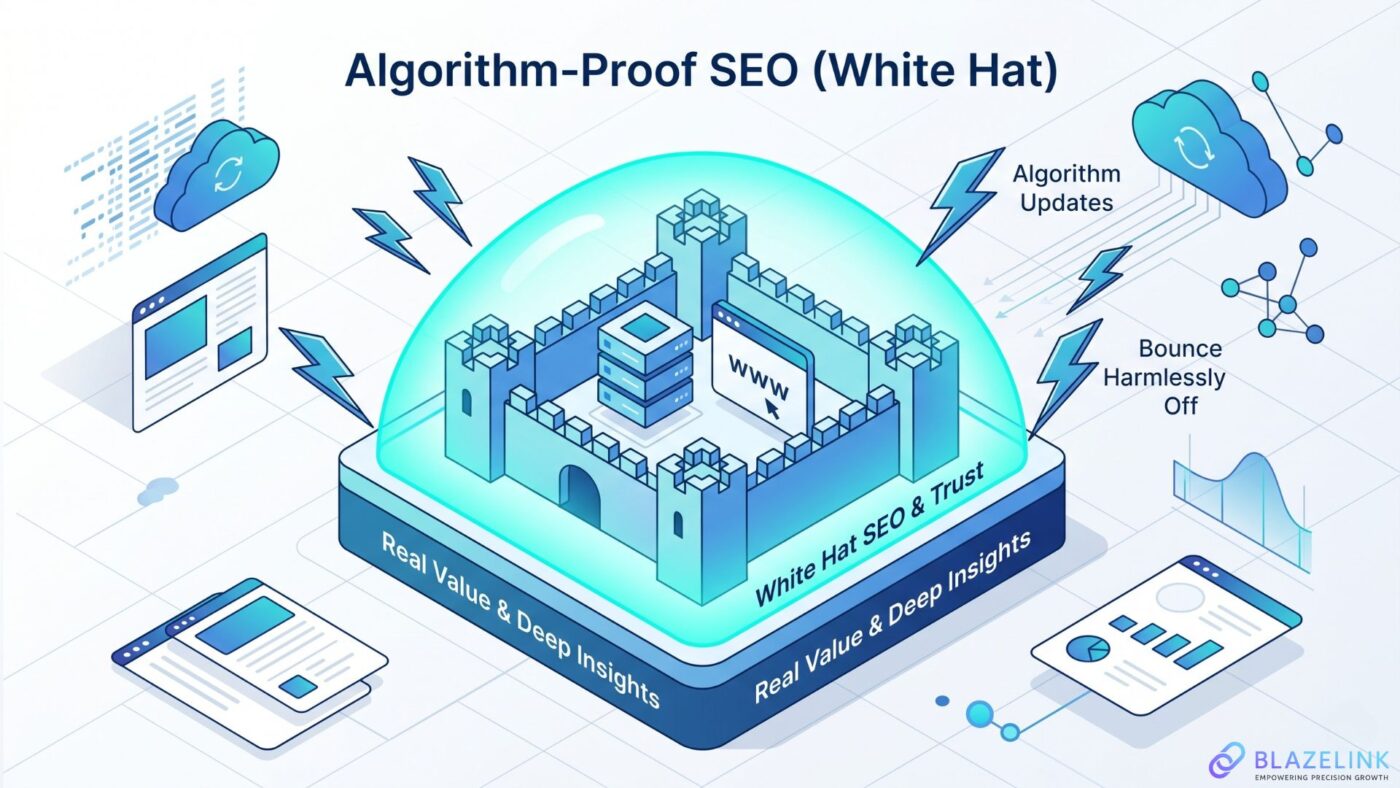
Google’s algorithms update frequently. Many sites relying on content farms or mass-generated, low-quality AI articles see their traffic drop to zero overnight.
A true SEO strategy must be built on White Hat SEO. The core of White Hat isn’t just “following Google’s rules”; it’s fundamentally about genuinely wanting to help the reader on the other side of the screen.
When we design SEO Topic Clusters, our starting points are always:
- What challenges are our clients currently facing?
- What unique perspectives or practical experience can we provide?
- After reading this article, will their anxieties be concretely resolved?
When you consistently produce in-depth, highly trusted content that solves real problems, algorithm updates won’t penalize you. Instead, they will weed out your inferior competitors and push your site higher. A high level of trust is the most invaluable moat for professional services and B2B brands.
The Underlying Logic of Precision Marketing: A Data Dialogue Between GA4 and GSC
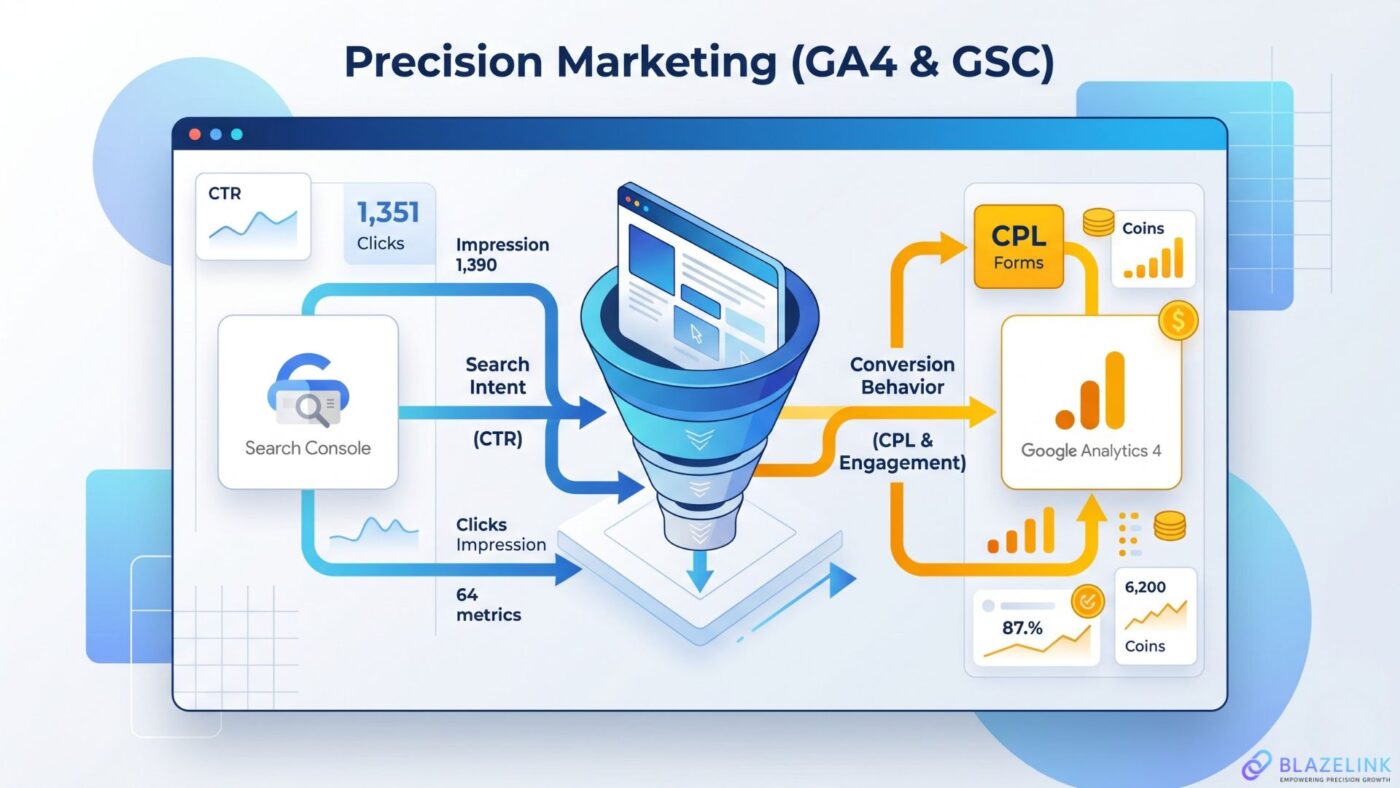
Lead-Gen SEO isn’t based on gut feelings; it’s driven by data. Through the lens of precision marketing, Google Search Console (GSC) and Google Analytics 4 (GA4) are two indispensable searchlights.
- GSC (Reveals Search Intent): Tells us what happens before the client enters the website.
- GA4 (Reveals Conversion Behavior): Tells us the decisions the client makes after entering the website.
3 Practical Metrics for a Quick Performance Check:
- Click-Through Rate (GSC CTR): If a commercial keyword ranks on the first page but the CTR is below 2%, it means the Title and Meta Description missed the client’s pain point and failed to attract clicks.
- Engagement Rate & Time on Page (GA4): If a specific Landing Page has an extremely high bounce rate or an average engagement time under 10 seconds, there is a severe disconnect between the “intent of the visit” and the “page content.” The copy must be revised immediately.
- Cost Per Lead (CPA/CPL): By combining SEO investment costs with the volume of GA4 conversion events, we can precisely calculate the cost of every organic search lead, thereby evaluating the true ROI.
Practical Challenges in Red Ocean and Blue Ocean Markets
In practice, driving digital transformation and marketing strategy often presents challenges, which generally fall into two categories:
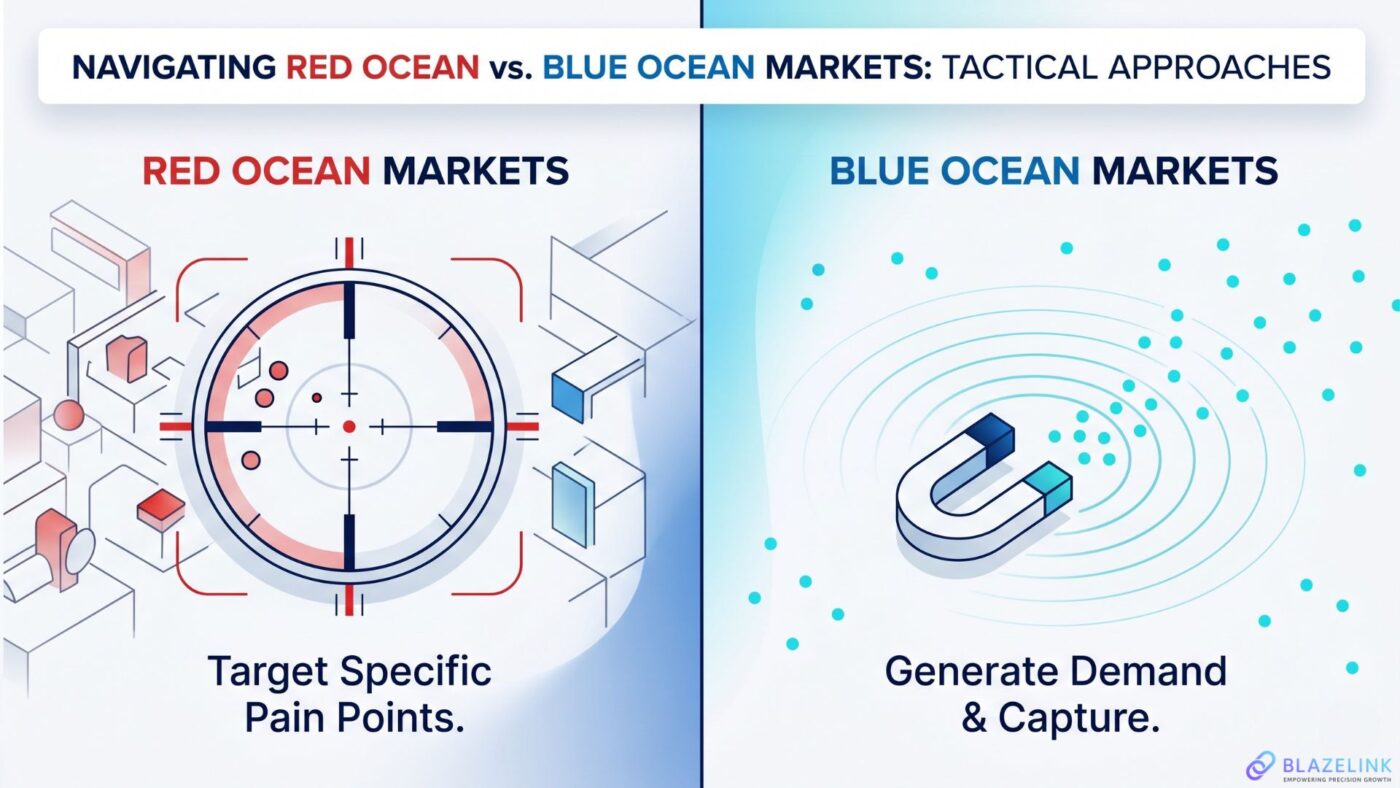
In Red Ocean Markets (e.g., E-commerce, Professional Consulting, Legal/Accounting, SaaS)
In these highly mature sectors, traditional “head terms” (e.g., Top Accounting Firms, ERP Systems) have long been dominated by well-funded enterprises or media platforms. Throwing budget at these keywords is not only cost-prohibitive but usually only attracts price-shoppers.
The practical solution is to build hyper-vertical “pain point themes.” Ditch broad service overviews in favor of dedicated solution pages tailored to specific scenarios and specific industries, paired with a marketing funnel. For example, embed a downloadable checklist or a cost calculator for a specific pain point directly on the page. This lowers friction and precisely captures high-intent buyers.
For instance, imagine a mid-sized accounting firm. If they stubbornly target the broad keyword “Accounting Firm,” they won’t outrank the Big Four, and the traffic will mostly be college students job-hunting or researching. Conversely, if they focus resources on precise long-tail keywords like “Cross-border E-commerce VAT filing process” or “Foreign company setting up a Taiwan branch tax risks,” they target business owners or CFOs facing urgent issues. Paired with an in-depth article that guides them to download a “Tax Checklist for Foreign Businesses in Taiwan” in exchange for contact info—that is the kind of Lead-Gen SEO that secures high-ticket contracts.
In Blue Ocean Markets (e.g., Niche Tech B2B Manufacturers, Emerging Tech, Innovative Business Models)
No one in the market is searching for your service yet. The challenge here is “Demand Generation.” You must use educational content and industry trend analysis to guide potential clients to realize they have a problem, prompting them to search and find you.
In a blue ocean, aside from targeting long-tail keywords, you must integrate content marketing (social media or PR exposure) to proactively trigger demand. Once potential clients become problem-aware, you use SEO to catch them securely within your automated funnel. This demonstrates mastery over the entire marketing ecosystem, rather than just relying on search engines.
Audit Your Brand
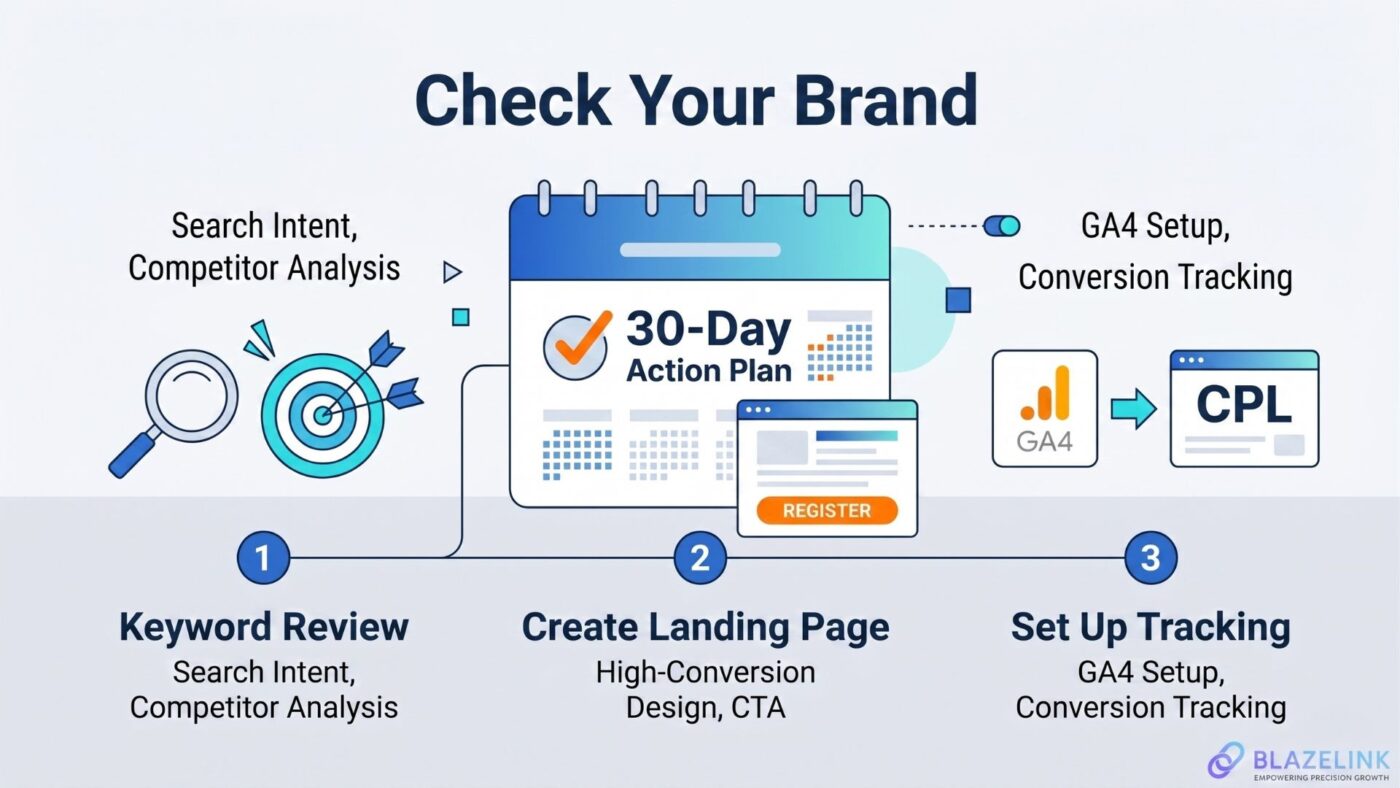
If you want your website to start generating high-value leads, I recommend reviewing these action items with your marketing team over the next 30 days:
- Audit Keyword Commercial Value: Review your top 10 ranking keywords. Categorize them into “Informational” (researching) and “Commercial” (seeking services/comparing). Reduce over-investment in non-converting terms.
- Build an MVP Landing Page: Select your most profitable or flagship service and build a dedicated one-page landing page for it. Ensure it features clear pain point descriptions, client testimonials, and a contact form.
- Implement Lead Tracking (GA4 Conversion Events): Stop looking only at traffic and impressions. Have an engineer or consultant set up proper conversion events (e.g., successful form submissions, messaging app clicks). Make “CPL” (Cost Per Lead) your core KPI for evaluating SEO performance.
Make SEO Your Most Reliable Digital Asset
To be candid, SEO has never been magic; it is a precise combination of science, logic, and psychology.
Ranking #1 is great, but it’s only part of the process. What truly sustains a brand’s long-term growth is the list of qualified clients who proactively reach out because they trust your content. Starting today, let go of the blind worship of traffic metrics. Pivot to Lead-Gen SEO and a high-converting landing page strategy, turning your website into your ultimate 24/7 business development tool.
If you are looking for more than just a ranking vendor—if you need a commercial growth partner who can simultaneously execute SEO strategy, full-stack web development, and GA4 data tracking—let’s chat. Let us clarify your brand positioning and build a high-conversion profit engine together.
/contact-2/Book a 1-on-1 Consultation >