
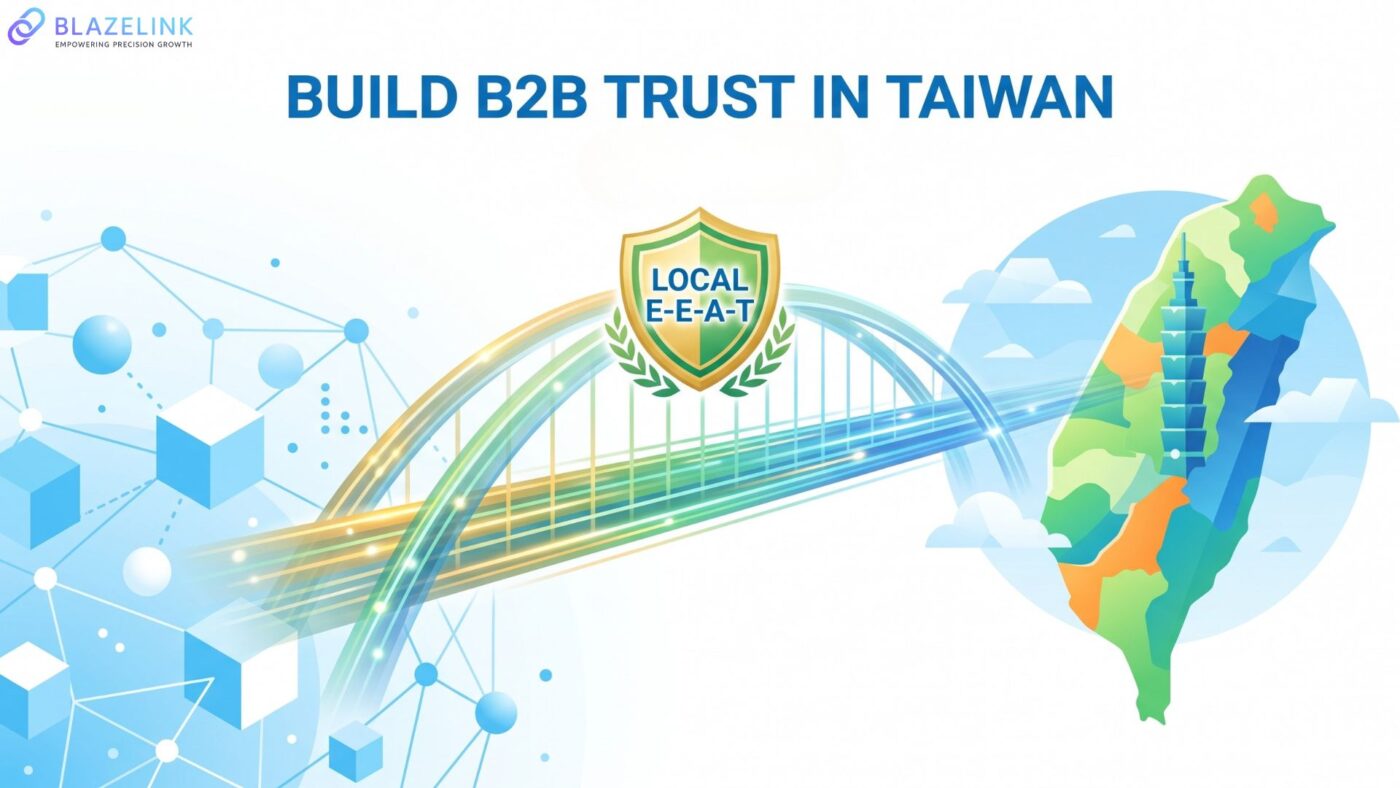
Here is a reality check for global B2B companies looking to expand into Taiwan: your international reputation does not automatically cross the ocean.
You might have a market-leading SaaS platform, a world-class consultancy, or an established compliance service. You may have even spent thousands of dollars translating your website into Traditional Chinese. Yet, your local pipeline remains completely stagnant.
On the surface, your localized site looks professional.
But here is the catch: Taiwanese B2B buyers are among the most risk-averse in the world. In high-knowledge sectors like legal, finance, and enterprise software, local procurement teams do not just buy features—they buy institutional stability. If you do not have a physical office in Taipei, your digital presence is the only proof that you are a legitimate, long-term partner who understands their market.
If your website fails to project deep, localized E-E-A-T (Experience, Expertise, Authoritativeness, Trustworthiness), Google Taiwan will quietly suppress your search rankings, and local buyers will flag you as a high-risk vendor before you ever get a chance to pitch.
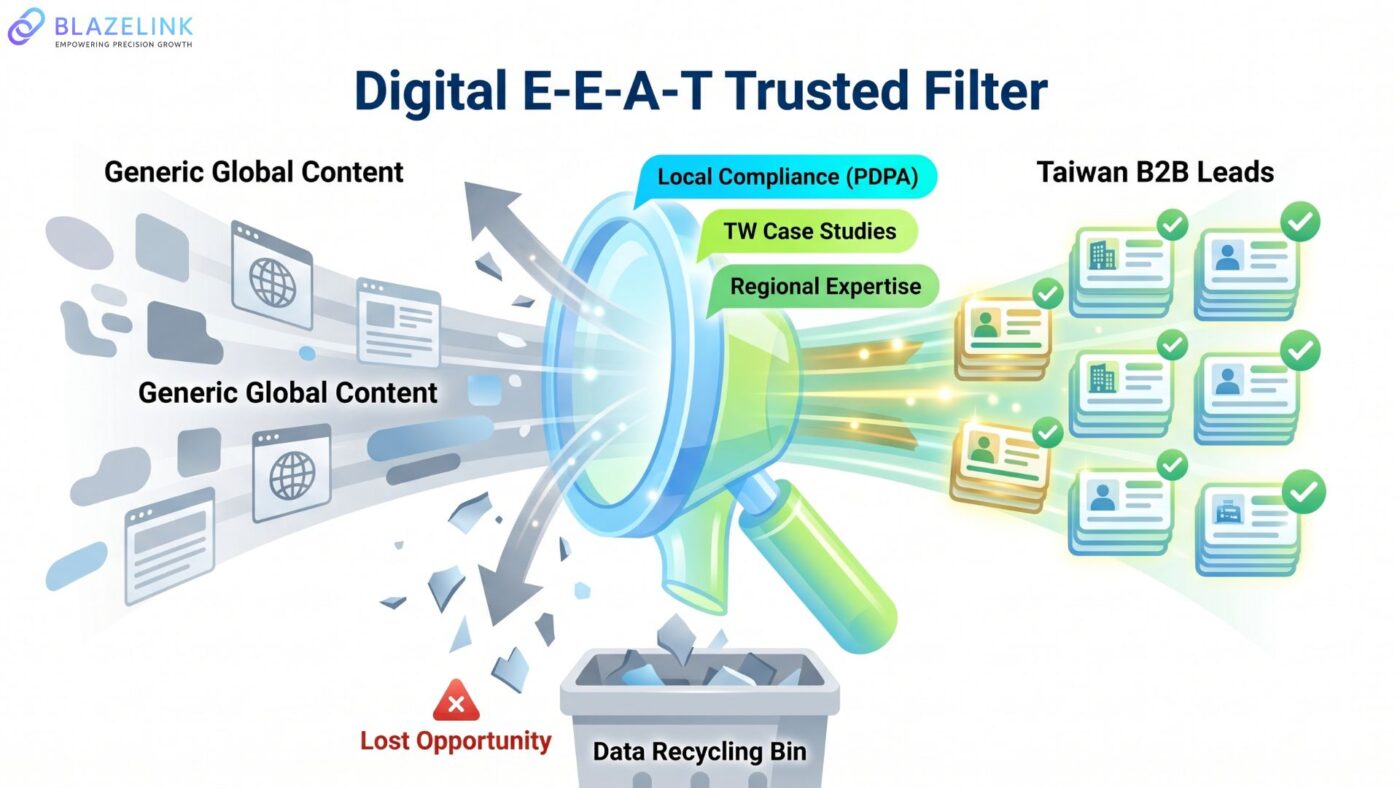
This digital trust deficit has intensified through early 2026, as Google’s search algorithms have become incredibly sophisticated at identifying whether a brand genuinely understands local regulatory, compliance, and cultural nuances. If you are trying to win Taiwanese clients entirely from a remote headquarters, generic localization is no longer enough.
The Invisible Barrier: Why Standard Translation Fails Local Search
When a procurement manager or CTO in Taiwan searches for an enterprise solution, they are not looking for a translated version of a global marketing pitch. They are looking for answers to highly specific local challenges—such as compliance with Taiwan’s Personal Data Protection Act (PDPA), integration with local ERP systems, or alignment with Ministry of Economic Affairs (MOEA) regulations.
If your website only offers standard, translated global content, two things happen:
First, Google recognizes that your content lacks local contextual relevance. It will prioritize local competitors who actively publish articles referencing Taiwan-specific laws, industry standards, and local case studies.
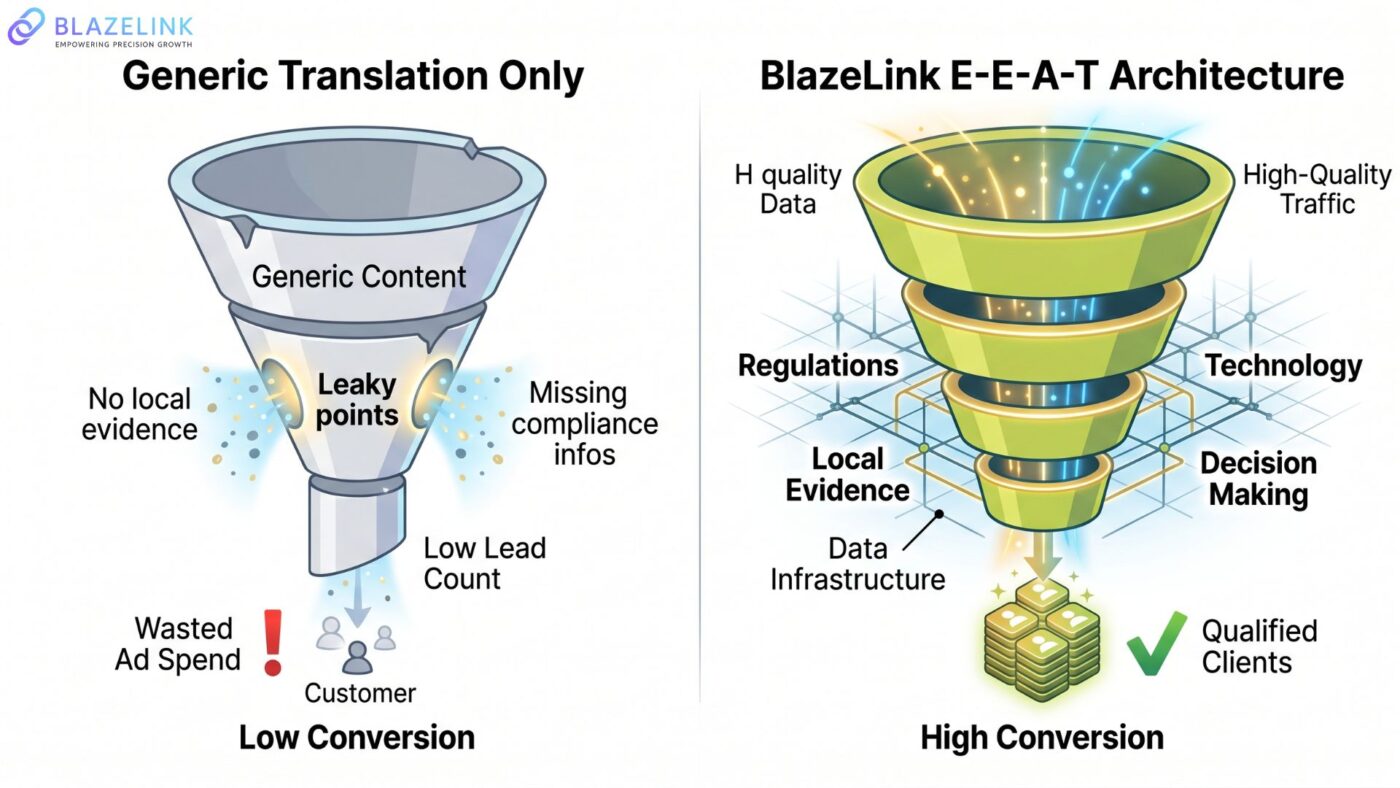
Second, even if you buy your way to the top via paid ads, the conversion funnel breaks the moment a prospect lands on your page. They see a site that looks Taiwanese because of the language, but feels completely foreign because it lacks local trust signals. No local client logos, no local address, and no understanding of how business is actually conducted in Taiwan.
A user clicks on your ad, senses the lack of local grounding, and exits. You pay for the click, but your competitor gets the lead.
The E-E-A-T Benchmark for High-Trust B2B Sectors
In professional and knowledge-intensive B2B industries, Google applies its strictest “Your Money or Your Life” (YMYL) evaluation standards. Recent search data shows that B2B sites failing to demonstrate authentic local expertise experience a dramatic drop in organic visibility when competing against domestic players.
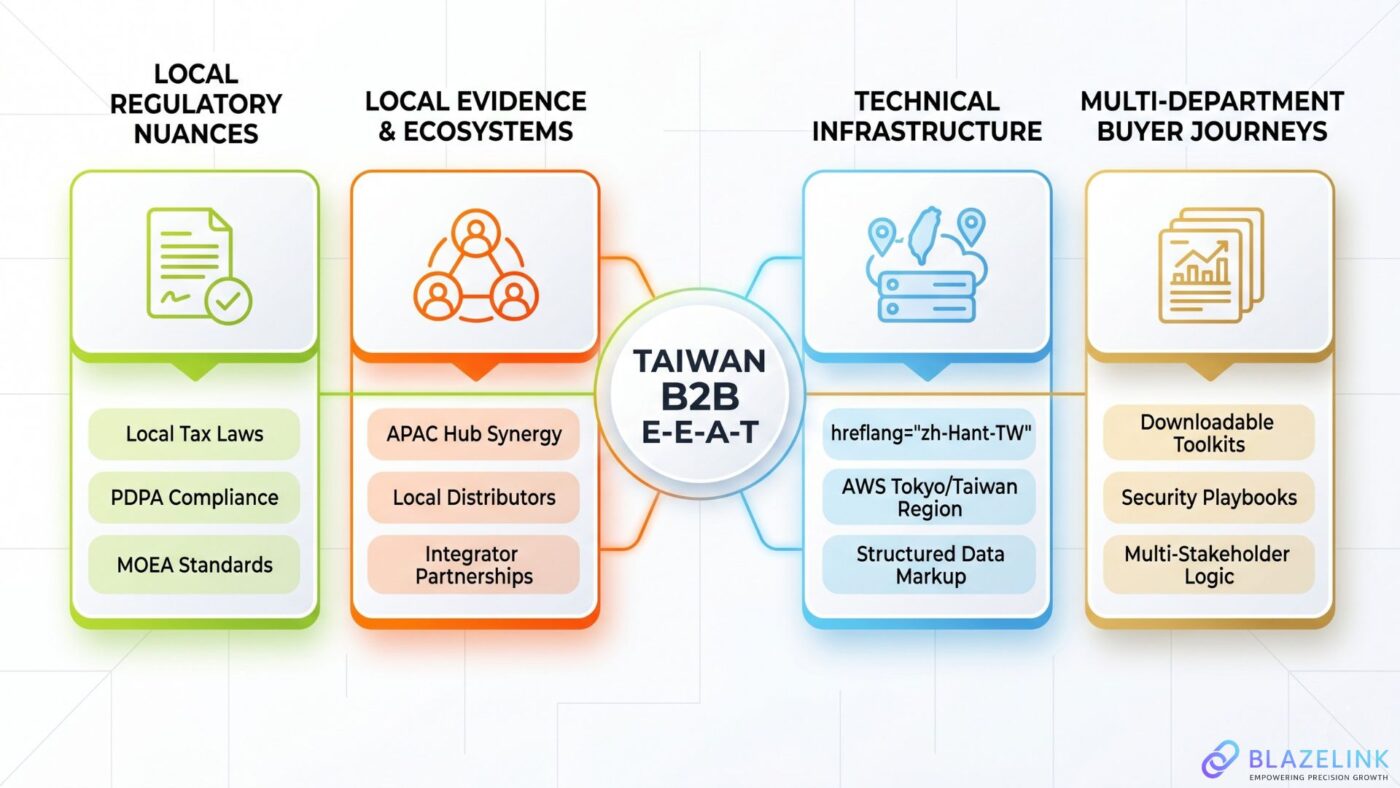
To bridge this trust gap before you even sign a local office lease, your digital infrastructure must address four critical pillars of localized E-E-A-T.
Four Pillars of Digital E-E-A-T for the Taiwan B2B Market
Building digital authority in Taiwan requires shifting from a “translated global brand” to a “locally embedded expert.”
1. Frame Content Around Local Regulatory Nuances
Taiwanese B2B buyers operate in a strict compliance environment. Content that ranks and converts in Western markets often completely ignores the legal and operational frameworks that Taiwanese decision-makers care about.
Your English or generically translated content does not answer how your solution maps to local tax laws, financial audits, or government digital transformation mandates. To build authority, your content strategy must feature topic clusters built specifically around Taiwanese regulatory frameworks, demonstrating that your product or service is ready for immediate, low-risk local deployment.
2. Localize the Evidence, Not Just the Text
A case study highlighting a Fortune 500 client in New York carries surprisingly little weight with a traditional Taiwanese conglomerate. Local buyers want to see how you solved problems for businesses like theirs—operating within the same regional ecosystem, dealing with the same supply chain realities, and managing similar organizational hierarchies.
If you do not have Taiwanese clients yet, leverage APAC regional hubs or highlight partnerships with recognizable local distributors, consultants, or technology integrators. Showcasing these collaborative ecosystems signals to both Google and local buyers that you are already operationally trusted within their circle.
3. Optimize Technical Infrastructure for the Local Web
Search engines use specific technical signals to determine if a site is tailored for a specific region. Relying on a single global domain without localized optimization forces Google to make assumptions about your target audience.
To win in local search, you must implement flawless technical localization: deploying precise hreflang tags for zh-Hant-TW, ensuring your site is hosted on ultra-fast infrastructure (like AWS Tokyo or Taiwan regions) to eliminate latency, and structured data markup that clearly identifies your brand’s regional relevance. If your site takes too long to load from a local connection, or if search engines cannot parse your regional targeting, your organic visibility evaporates.
4. Design for Multi-Department, Relationship-Driven Buyer Journeys
B2B purchasing decisions in Taiwan rarely rely on a single stakeholder. They involve highly collaborative, consensus-driven committees spanning IT, legal, procurement, and C-suite executives who value long-term stability and meticulous risk assessment.
Your content architecture needs to serve this multi-layered journey. An auto-translated website rarely accounts for this high-touch, risk-averse procurement process. You need dedicated resources—such as downloadable technical compliance sheets, localized implementation playbooks, and clear security documentation—that a local champion can easily present to their internal board to justify selecting an overseas vendor.
How to Establish Immediate Digital Legitimacy
If you want to capture market share in Taiwan before making a heavy physical investment, you cannot rely on shortcuts or passive translation tools. You need a deliberate, localized digital footprint.
The most scalable approach is to build an authoritative, localized content engine alongside a technically sound MarTech setup. When local searchers find deep, highly contextual answers to their specific compliance and operational questions directly on your domain, the perceived risk of doing business with a remote vendor drops significantly.
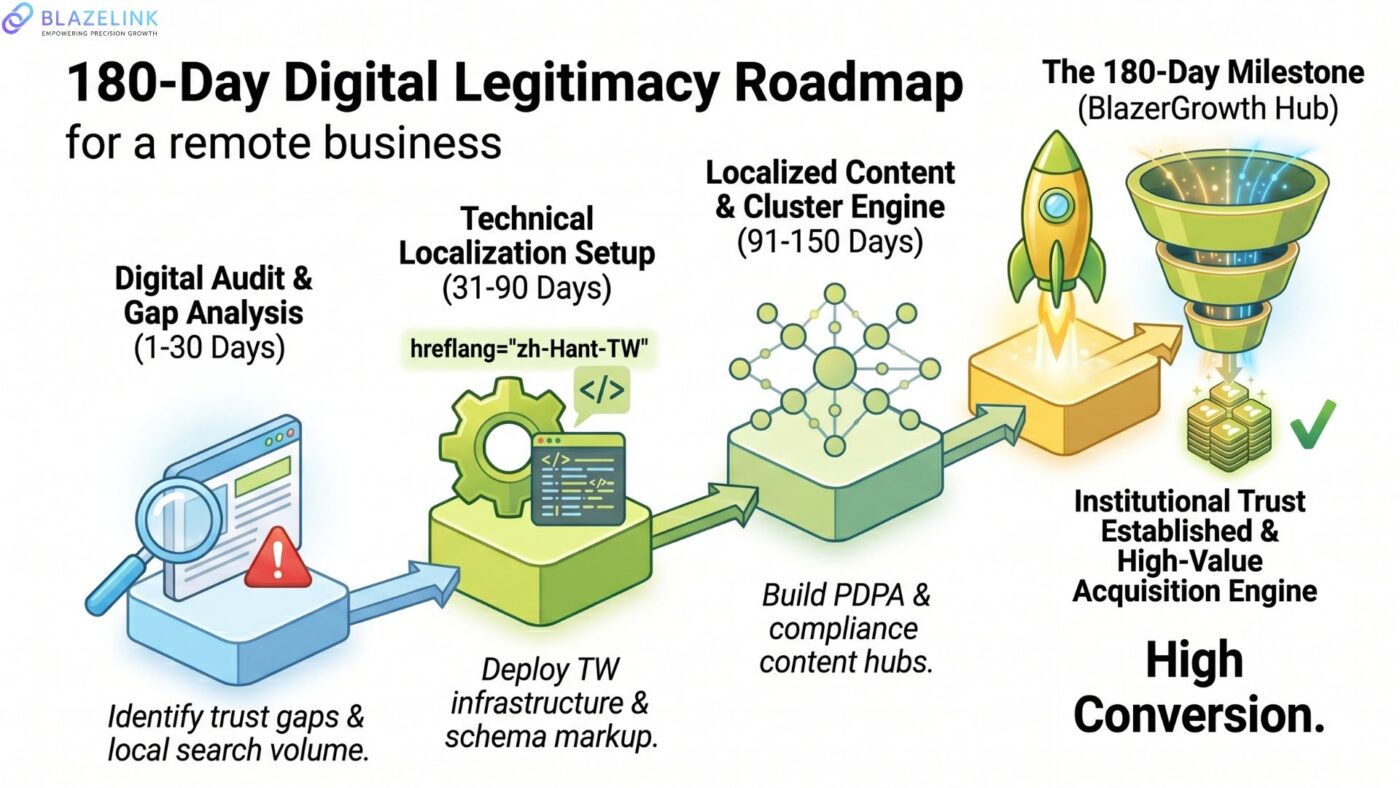
For international businesses serious about entering Taiwan’s high-value B2B sectors, the journey begins with an audit of your current digital footprint: identifying how local buyers search for your solutions, uncovering critical trust gaps on your website, and deploying a high-impact technical and content roadmap.
That is precisely what BlazeLink specializes in. We design precision marketing funnels, localized SEO architectures, and automated data engines that build institutional trust from day one. If you want a clear strategy to win local enterprise clients, we are here to map out your 180-day growth plan.
Get Your International Traffic Consultation >