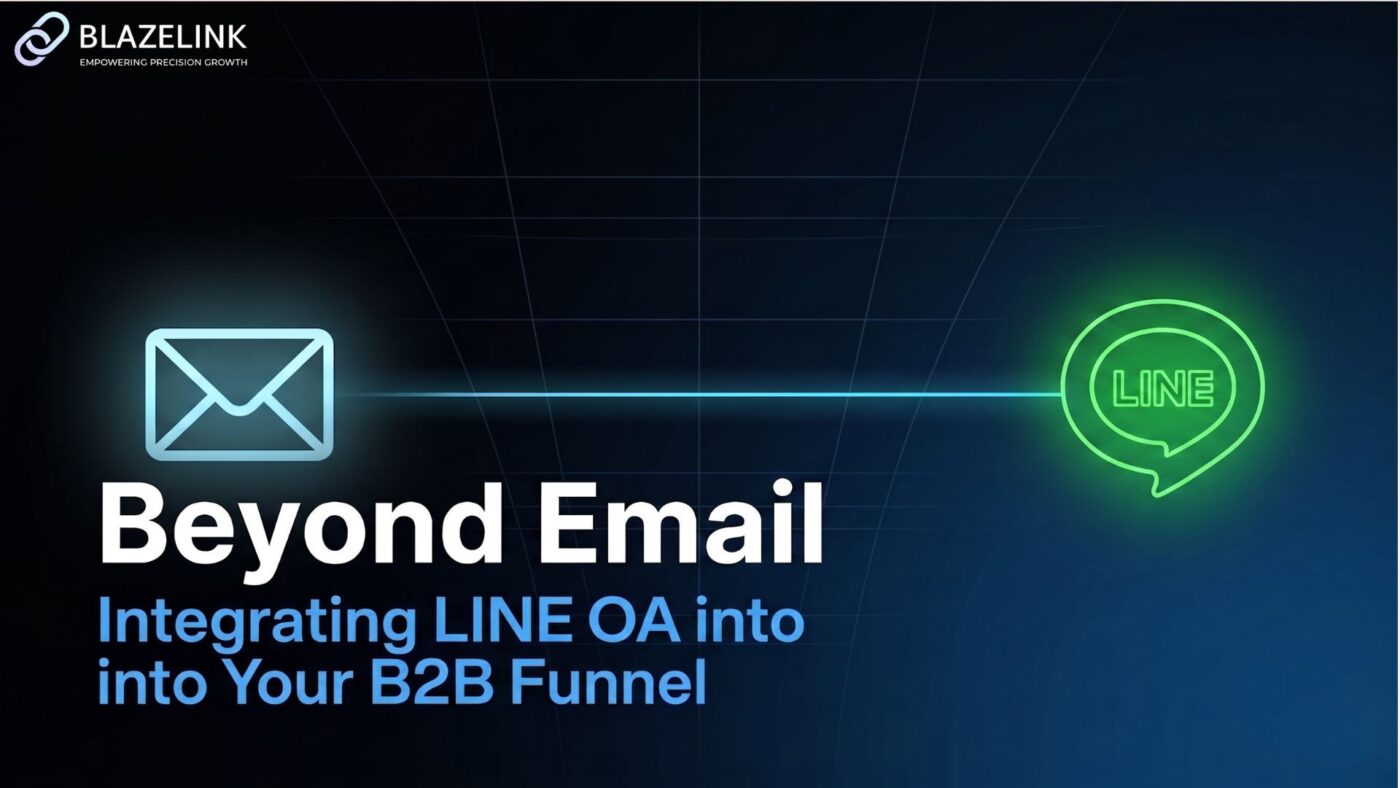
Why do Western B2B email funnels fail in Taiwan?
While Western markets rely heavily on email nurturing, Taiwanese professionals use email primarily for formal documentation. Incorporating a LINE Official Account bridges this conversational deficit, boosting engagement from a standard 20% email open rate to over 70% inside LINE’s native ecosystem.
For many international B2B brands and SaaS companies entering the Taiwanese market, the lead generation playbook looks identical to the one used in the US or Europe: build a high-converting landing page, offer a high-value whitepaper or tool, capture an email address, and enroll the prospect into a 5-part automated email nurturing sequence.
A few months later, the marketing dashboard reveals a frustrating reality. While the initial lead acquisition numbers might look decent, the email open rates are dismal, click-through rates are hovering near zero, and the sales pipeline remains dry. The common assumption is that the market is too small, or local B2B buyers are slow to adopt foreign solutions.
But the real problem lies elsewhere: you are running a Western communication playbook in an ecosystem built on entirely different conversational infrastructure.
Just as translating your website text without localized SEO fails to capture true search intent, copy-pasting a standard email-only nurturing funnel into Taiwan ignores how local professionals actually conduct business. In Taiwan, email is used for formal documentation and contracts; LINE is where the actual relationship, evaluation, and buying decisions happen.
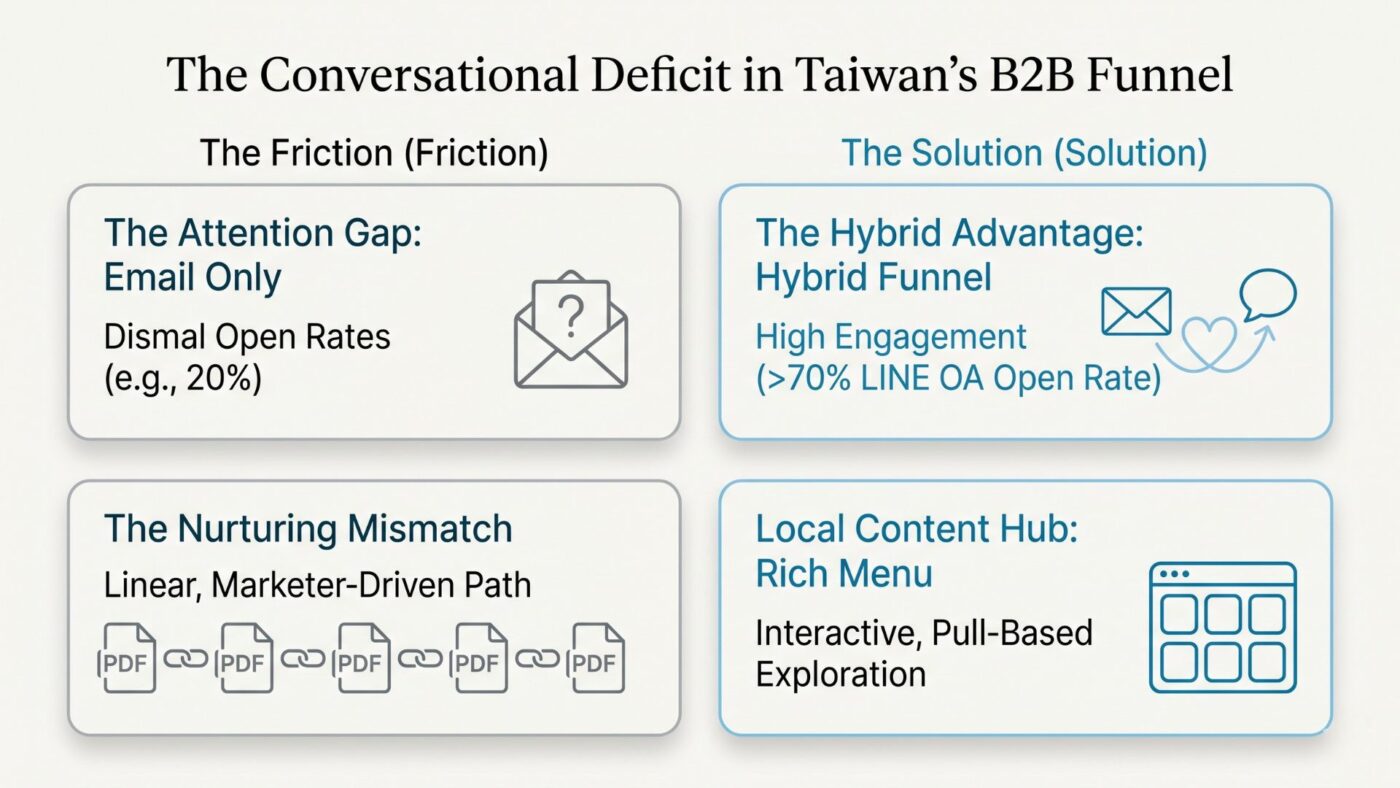
The Conversational Deficit in Taiwan’s B2B Funnel
In Western markets, email is the undisputed king of B2B lead nurturing. In Taiwan, however, a website that relies solely on email to move a prospect from awareness to decision introduces friction at every stage of the content architecture.
When a B2B lead generation funnel is built without integrating a LINE Official Account (LINE OA), four distinct operational gaps occur within your local marketing architecture:
1. The Attention Gap: Open Rates and Friction
The standard B2B email sequence struggles against crowded inboxes, strict corporate spam filters, and a cultural preference for instant messaging. While a well-optimized B2B email sequence might achieve a 20% to 25% open rate, LINE messages regularly achieve open rates exceeding 70% to 80%.
By forcing a Taiwanese professional to interact purely via email, you are choosing a channel where they are structurally less active, extending your sales cycle and reducing your touchpoint frequency.
2. The Content Journey Mismatch
A standard email funnel presents content in a linear, rigid sequence determined by the marketer. However, local buyer journeys are rarely linear.
When a prospect hooks into your LINE OA, they interact with a Rich Menu—a customizable, tiled navigation interface at the bottom of the chat screen. This turns the chat window into an interactive, self-service content hub. Prospects can browse case studies, calculate pricing, or review compliance details at their own pace, transforming a passive push channel into an active, pull-based exploration tool.
3. Market-Specific Trust Signals (EEAT)
In high-stakes professional services, legal frameworks, and B2B SaaS, establishing authoritativeness and trustworthiness is critical. In Taiwan, a verified LINE Official Account (distinguished by a blue or green shield badge) acts as an immediate local trust signal.
It reassures the buyer that your business is locally registered, operational, and accessible. An unverified foreign brand communicating solely through cold corporate emails lacks this native layer of institutional credibility.
4. Technical Architecture Fragmentation
Many companies treat LINE merely as a broadcast channel for promotional blasts, running it completely separate from their core marketing tech stack. This creates a highly fragmented technical structure.
Without deep integration between your website (e.g., WordPress/WooCommerce), your CRM (e.g., HubSpot or Salesforce), and the LINE Messaging API, you cannot track user behavior across channels. You lose the ability to trigger real-time chat interventions based on web behavior, running the exact same technical risks as a site operating without proper multilingual infrastructure.
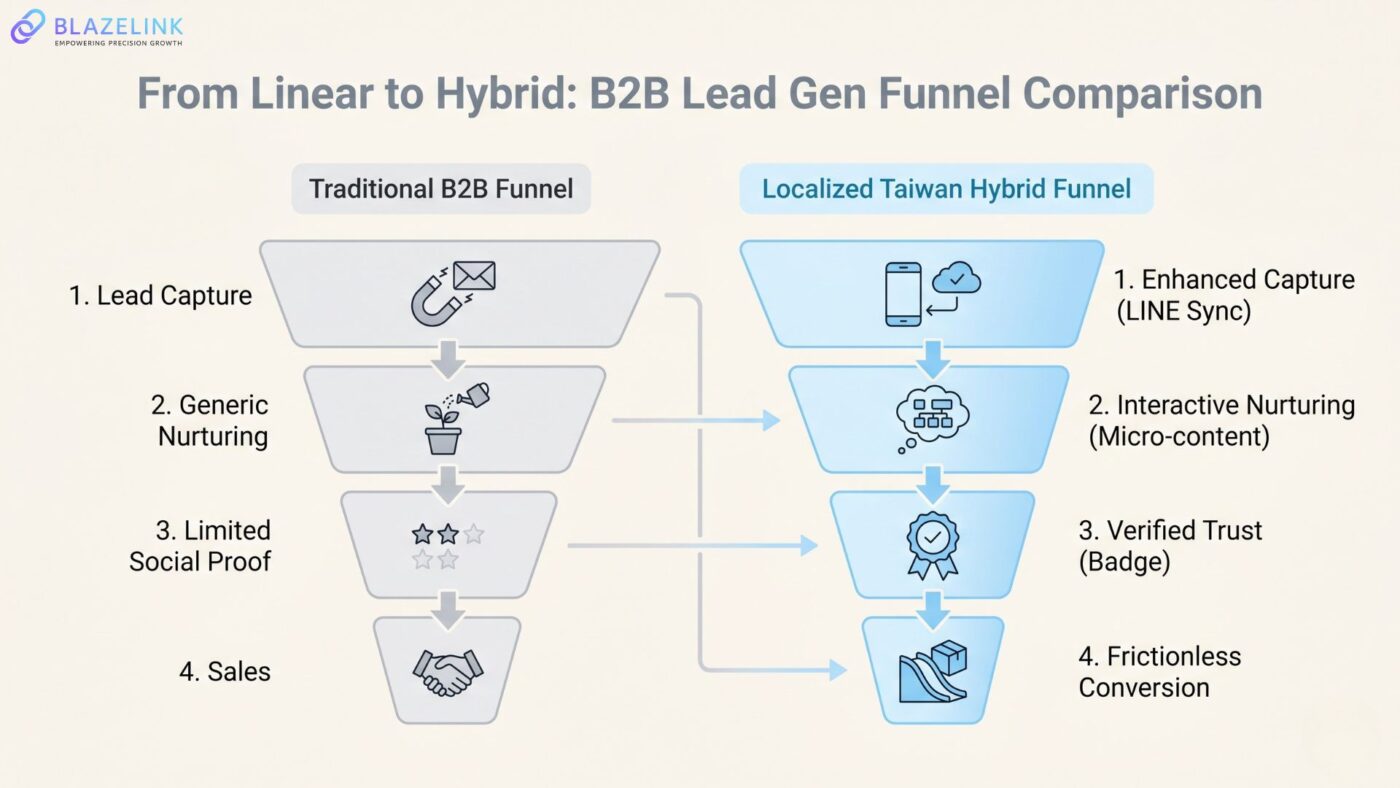
Mapping the Hybrid B2B Funnel: Email vs. LINE OA
To win high-value B2B retainers or enterprise software deals in Taiwan, the optimal strategy is not to abandon email entirely, but to build a hybrid funnel that leverages both channels according to their strengths.
| Funnel Stage | Traditional Western Playbook | Localized Taiwan Hybrid Playbook |
| 1. Lead Capture | Web Form $\rightarrow$ Email Opt-in | Web Form $\rightarrow$ Dual Opt-in (Email + LINE Login Social Sync) |
| 2. Lead Nurturing | 5-Day Automated Email Drip | High-level content via Email; Interactive micro-content & case studies via LINE Chat |
| 3. Trust Building | Whitepapers & Case Study PDFs | Interactive Rich Menu with localized trust signals, FAQ automation, and verified badges |
| 4. Conversion / Sales | “Reply to this email” or Calendly | One-click LINE booking, direct customer service chat, or automated interactive quote tools |
Actionable Steps: Building a LINE-Integrated Funnel
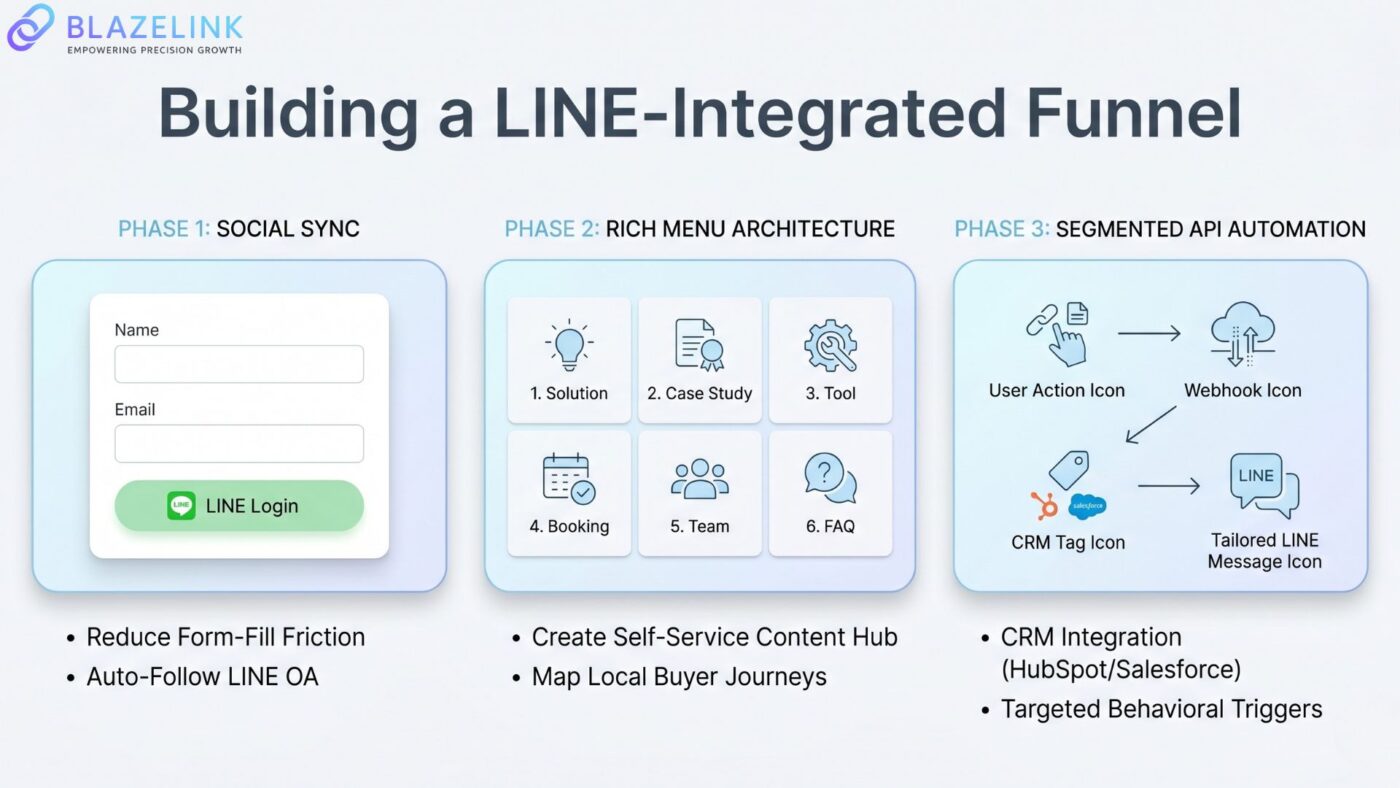
Integrating LINE OA into your B2B infrastructure requires a deliberate mix of content strategy and marketing automation setup.
Phase 1: High-Value Lead Capture with Social Sync
Instead of utilizing standard form fields that require manual typing, implement LINE Login on your landing pages. With a single click, the prospect grants permission to share their professional contact details while automatically following your LINE Official Account. This completely removes form-fill friction on mobile devices.
Phase 2: Architecture of the Rich Menu
Design your LINE Rich Menu to mirror the specific evaluation stages of a high-trust buyer journey. Divide your menu tiles into logical action items:
- Product/Service Capabilities: Direct links to your optimized local solution pillars.
- Social Proof: Localized case studies, client logos, or industry compliance certifications.
- Instant Utility: A built-in calculator, tool, or automated FAQ engine that solves an immediate problem.
- Direct Consult: A direct trigger to speak with a human consultant or book a meeting.
Phase 3: Segmented API Automation
Avoid mass broadcasting to your entire LINE database—this leads to immediate block rates. Instead, use webhooks via platforms like Make.com, Zapier, or native CRM integrations to trigger highly segmented, behavioral LINE messages:
Example Workflow: If a lead downloads an enterprise security whitepaper on your English or translated website, the CRM tags the contact. Instead of waiting for an email, the LINE API instantly triggers a highly tailored message inside the chat app 2 hours later: “Hi [Name], saw you were looking into our security protocols. Here is a quick 2-minute video on how we comply with Taiwan’s personal data protection laws.”
Unlocking Localized Growth
Entering Taiwan’s B2B market involves more than translating marketing collateral word-for-word. It requires adapting to the local digital environment and aligning your content delivery with how decision-makers communicate daily.
If your current marketing funnel relies strictly on traditional, single-channel Western playbooks and you are looking to unlock real pipeline growth in Taiwan, the solution is an honest assessment of your current localized marketing architecture.
BlazeLink specializes in bridging the gap between strategic growth frameworks and local technical implementation. We can audit your current lead generation structure, map out your cross-channel data flow, and build a practical 180-day funnel modernization roadmap tailored to your specific industry.