


When Western brands decide to expand into East Asia, the initial playbook almost always looks the same. They take their high-performing English website, hire a native translator to convert the copy into Traditional Chinese, publish it on a new subdirectory, and wait for localized leads to fill their pipeline.
A few quarters later, the data tells a frustrating story. Organic traffic from the region is practically non-existent. The few localized users who do land on the page bounce within seconds. The sales team complains that the market is “too insular” or “unresponsive to Western solutions.”
But the market isn’t unresponsive. The actual issue is a structural mismatch in your digital strategy.
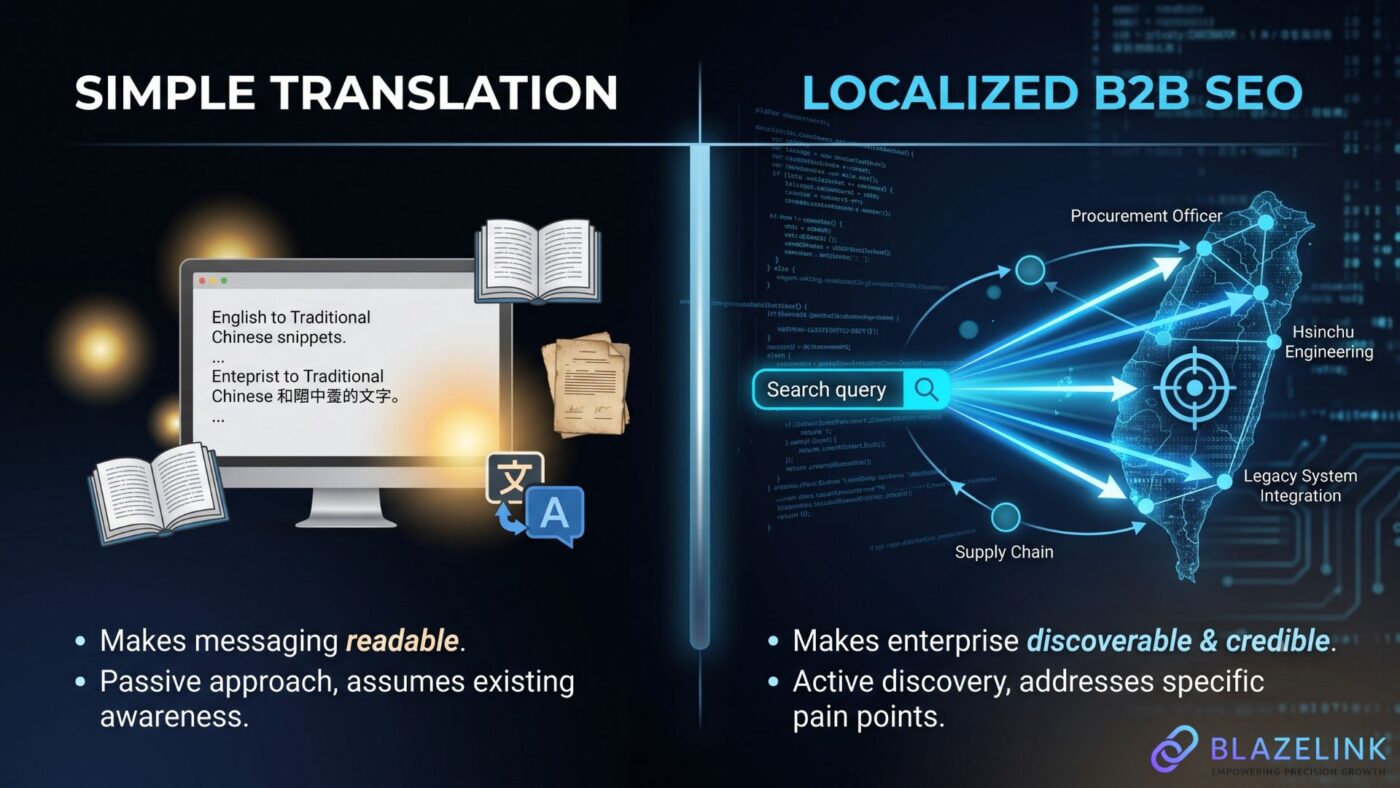
Translation and localized market acquisition serve two completely different functions. Translation makes your existing corporate messaging readable in another language. Localized search engine optimization makes your enterprise discoverable, credible, and competitive within a totally distinct business ecosystem and search culture.
When you skip the strategic layer beneath the language, you build a website that search engines have no technical reason to reward—and that local enterprise buyers have no practical way of finding.
The Illusion of Language-First Localization
A flawless, professional translation possesses real business value. If a local procurement officer already knows your brand name from an international trade show and types your URL directly into a browser, an elegant Traditional Chinese interface allows them to understand your product specifications.
But this scenario assumes the buyer already knows you exist. For an expanding Western firm entering Taiwan’s high-trust B2B landscape, that assumption rarely holds true.
The vast majority of your potential partners—whether they are semiconductor manufacturers in Hsinchu, supply chain logistics giants, or enterprise software distributors—will encounter your business by searching for a highly specific operational problem they need to solve. Whether your localized page ever surfaces in those high-stakes queries depends entirely on mechanics that translation cannot influence.
Translation focuses on vocabulary. Localized B2B SEO governs visibility, systemic trust, and alignment with the actual cultural mechanics of localized search.
Three Invisible Gaps Defeating Your Translated B2B Funnel
When a Western B2B website is translated without a localized search strategy, three deep architectural gaps quietly format-kill its performance.
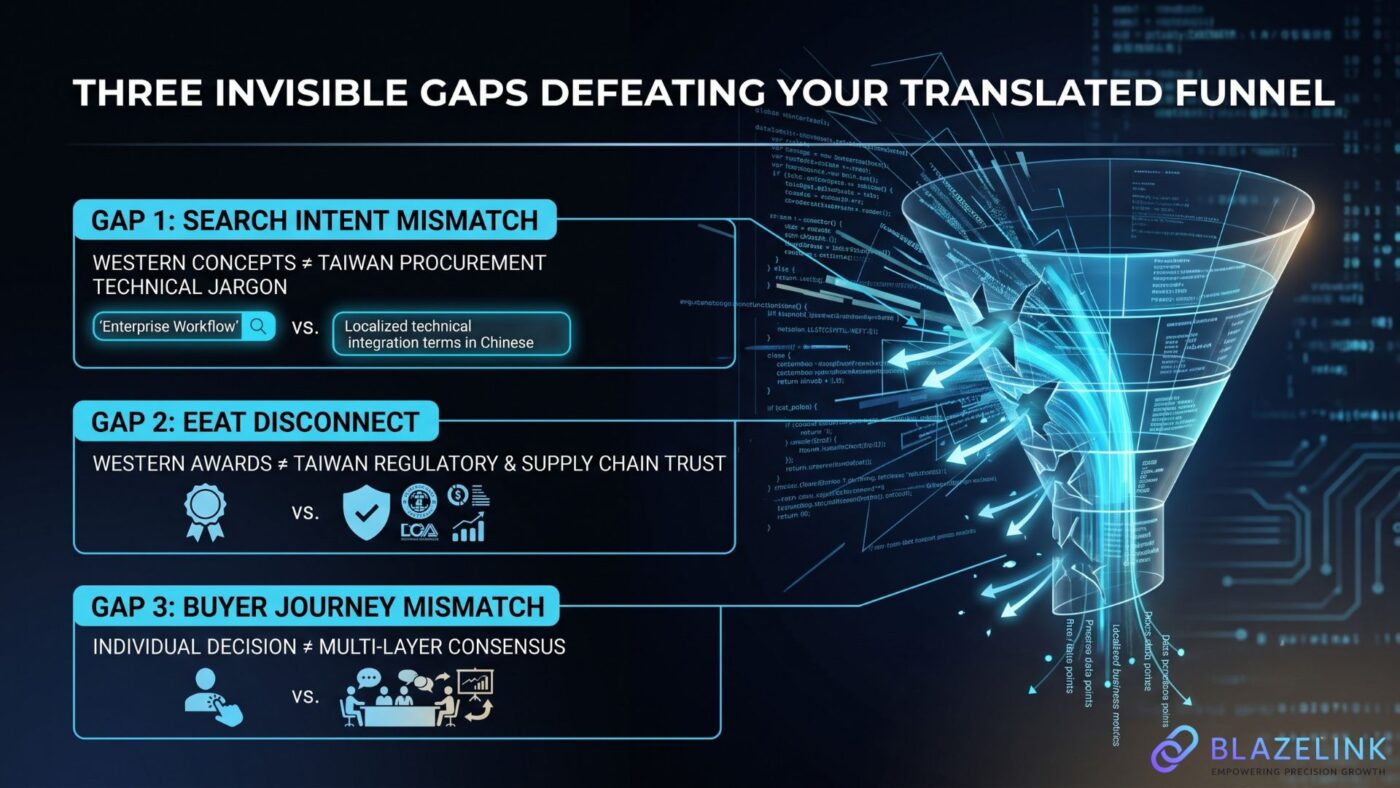
1. B2B Search Intent Does Not Translate Word-for-Word
The phrases your engineering or operations teams use in the US or Europe are rarely direct mirrors of what a Taiwanese B2B buyer types into a search engine when facing the exact same challenge. Business cultures frame operational pain points differently, utilize distinct technical jargon, and proceed through different logical sequences during a procurement research phase.
A translated page inherently inherits the keyword architecture of the original market. For instance, a Western SaaS firm might target the high-level concept of “Enterprise Workflow Automation.” A direct translation into Traditional Chinese targets a phrase that local corporate buyers rarely use with commercial intent. Instead, a Taiwanese IT manager might search for hyper-specific compliance frameworks, platform compatibility terms, or legacy system integration shorthand.
Winning a local market requires discarding the original keyword seed list and building research from scratch. The objective is never to find a local word for an existing keyword; it is to map the specific phraseology your local audience utilizes when they are actively ready to sign a corporate contract.
2. EEAT Signals Carry Regional Weight
In high-stakes corporate procurement, technology sourcing, and professional services, Google applies an extraordinarily strict standard of evaluation popularly known as EEAT (Experience, Expertise, Authoritativeness, and Trustworthiness). In sectors where data security, substantial budgets, or operational compliance are on the line, these trust markers dictate search visibility.
A basic translation preserves the credentials that established your authority back home: Western industry awards, case studies featuring Fortune 500 brands in Ohio, or quotes from Western publications. While these are objectively impressive, they carry significantly less psychological and algorithmic weight with a local Taiwanese buyer or a localized search crawler.
Local search intent expects local reassurance. Building authentic authority requires restructuring your profile to emphasize compliance with local data protection acts, showcasing case studies with recognizable Asian supply chain nodes, and earning citations from regional trade authorities. Translation changes the font; it does not cultivate trust.
3. Content Architecture Ignores the Local Consensus-Driven Journey
A B2B website’s structure—its topic clusters, technical whitepapers, and internal link routing—should mirror the precise steps a buyer takes from initial awareness to booking a consultation.
In many Western corporate environments, the digital buyer journey is designed for individual efficiency: read a concise landing page, download a self-serve brochure, and request a demo. However, Taiwanese enterprise purchasing is notoriously consensus-driven, risk-averse, and multi-layered.
A local evaluation squad may require deep, exhaustive, structural documentation, step-by-step localization roadmaps, and heavily structured comparison data early in the awareness phase. A website architecture that works perfectly as a sleek, minimalist conversion funnel in London can feel superficial, untrustworthy, or incomplete to a corporate research team in Taipei.
The 2026 Imperative: Optimizing for AI Sourcing Engines
There is a modern layer to this problem that makes a language-only shortcut even more dangerous.
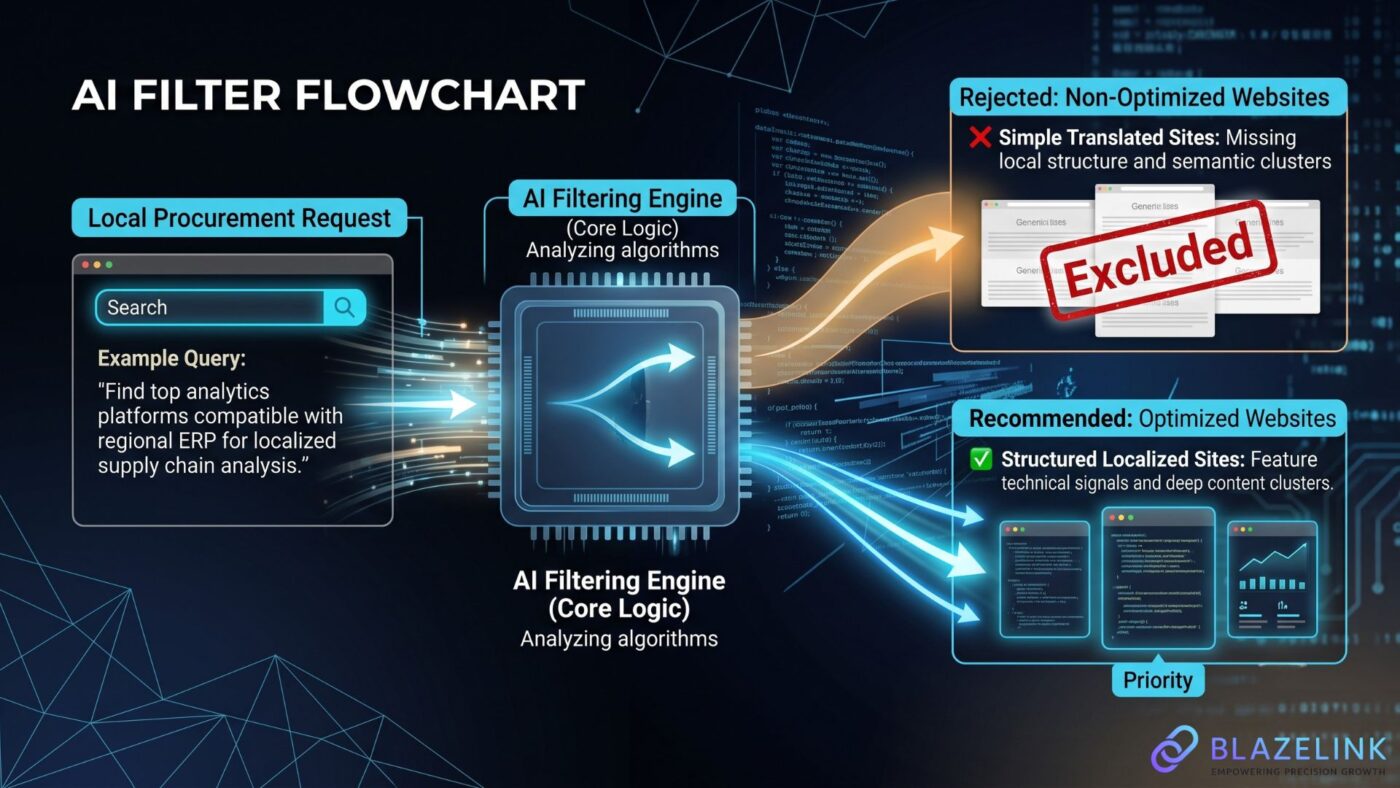
Enterprise procurement teams are increasingly bypassing traditional search results entirely. Instead, they utilize generative AI engines—such as ChatGPT, Perplexity, and highly specialized localized LLMs—to conduct preliminary market scans and vendor sourcing. When a local manufacturing executive asks an AI system to “List the top international data analytics platforms compatible with our specific regional ERP architecture,” the AI does not translate random English websites on the fly to find the answer.
AI systems recommend businesses based on well-organized, highly authoritative, and deeply structured content that explicitly addresses regional parameters. If your digital footprint lacks proper technical metadata, localized topic clusters, and contextual references tailored to the local market, AI engines will simply exclude you from their summaries. You will remain completely invisible to the modern procurement pipeline, and your competitors with genuine localized search architecture will capture the entire market share.
Actionable Blueprint: Moving Beyond Translation
If you are serious about transforming your digital presence into an authentic engine for East Asian B2B partnerships, your strategy for the upcoming quarters must pivot from simple language conversion to structural market entry.
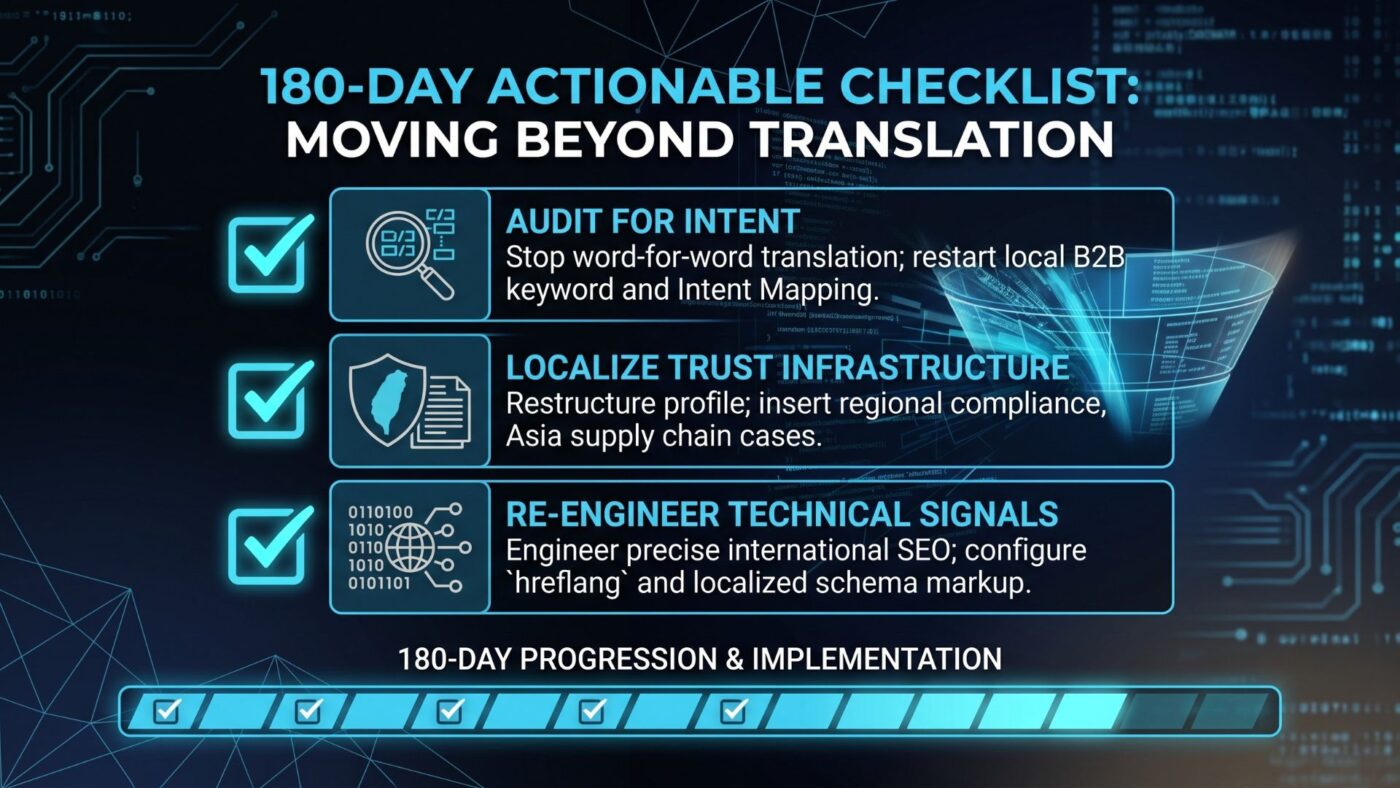
- Audit for Intent, Not Text: Halt literal content translation. Initiate a native B2B keyword mapping project to discover the precise friction points and technical queries your target corporate clients are typing into search engines.
- Localize the Trust Infrastructure: Revamp your pillar pages to feature trust signals that resonate regionally. Highlight your experience navigating regional supply chain challenges, cross-border data security laws, and localized technical integrations.
- Re-engineer Technical Signals: Ensure your development team implements precise international technical SEO—including flawless hreflang configurations and localized schema markup—so search systems accurately route the right pages to the right regional corporate searchers.
Unlocking Local B2B Growth
An underperforming localized website is rarely the fault of a poor translation agency. It is almost always the result of forcing translation to execute a strategic market-entry job it was never engineered to handle.
Entering a high-value market like Taiwan demands a digital foundation that speaks the language of both local business culture and search algorithm architecture. If you want to assess whether your current digital setup is genuinely positioned to capture international corporate demand, BlazeLink can help evaluate your technical infrastructure, analyze regional competitor search footprints, and build a highly actionable first-180-day growth roadmap. Let’s build a system that doesn’t just read well, but performs.
[ Get Your International Traffic Consultation in Taiwan’s Market ]