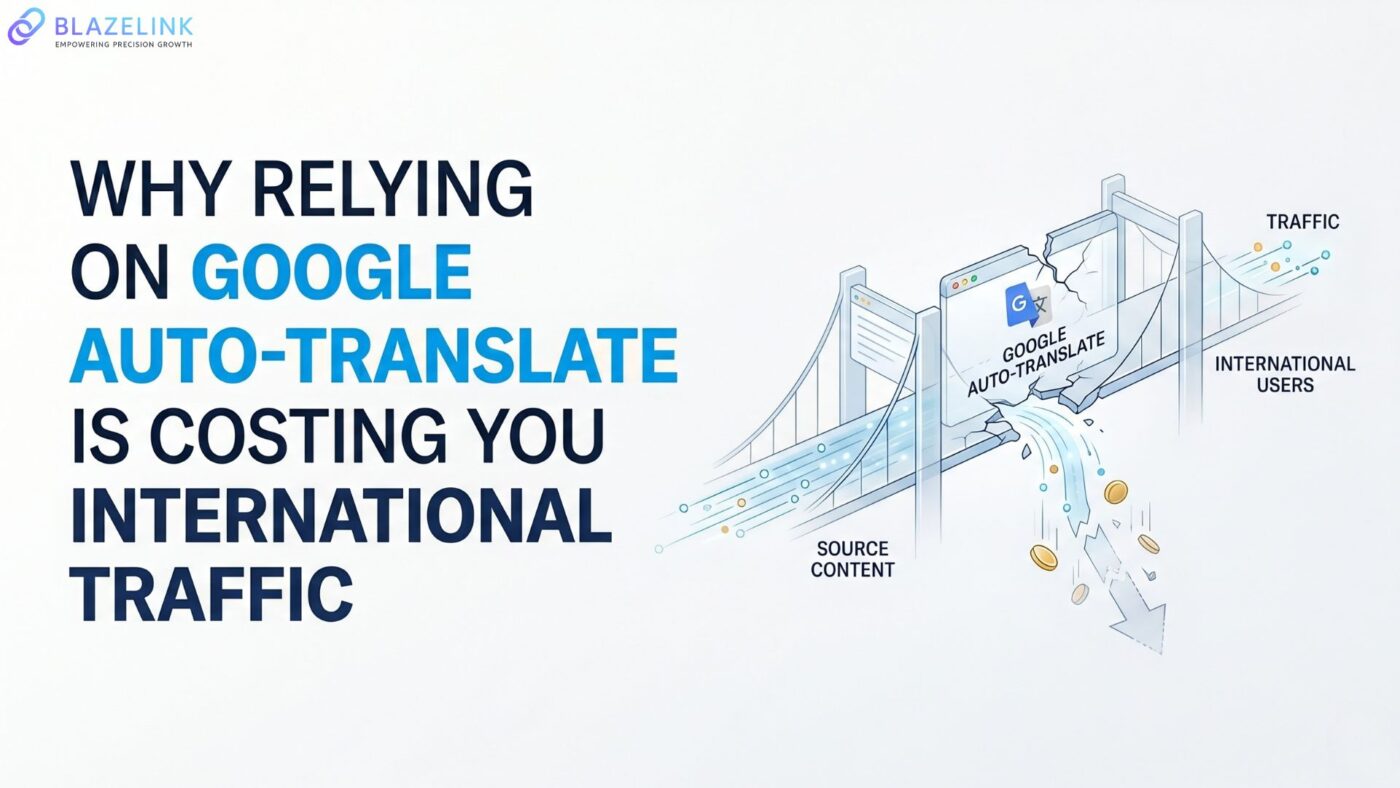
Here is something most business owners do not know is happening to them: if you have not built a proper English version of your website, Google may be showing your content to English-speaking audiences by translating your pages automatically and serving them to international searchers.
On the surface, that sounds helpful.
But here’s the catch: Google hosts those translated pages on its own domain. The visitors land on Google’s infrastructure, not your website. Because you don’t have a translated version of your site that serves a specific target audience, you get no traffic, no leads, and no credit, even though it was your content that brought readers there.
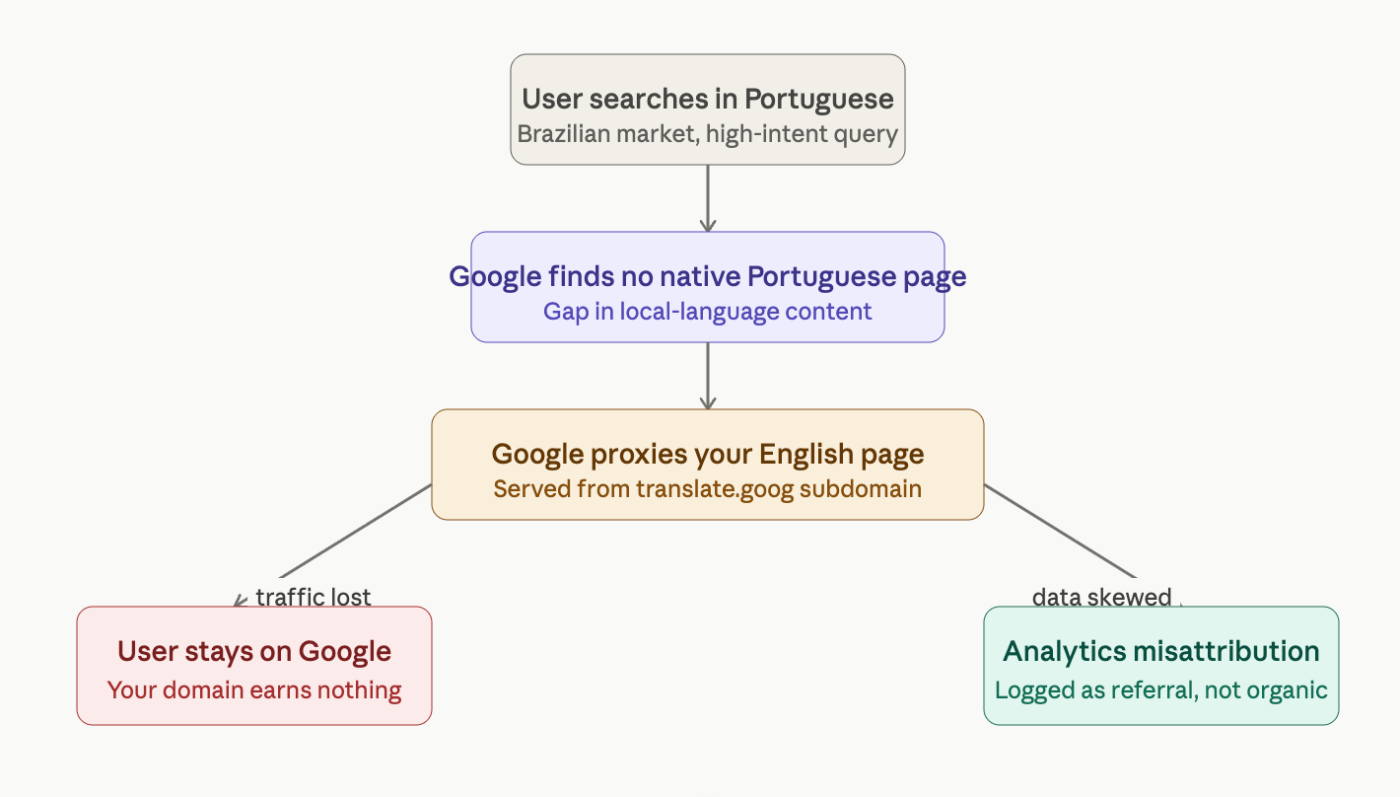
Let’s say users in Brazil are interested in your service or product: they will likely search for it in their native language, but Google will end up intercepting and stealing that traffic if you don’t translate your website properly.
This has been happening at a growing scale since Google’s March 2025 Core Update, and most affected businesses have no idea it is going on. Maybe your analytics look normal, and your traffic looks fine, but the international opportunity you were hoping to build is quietly being captured by someone else, and that someone else is Google. Ahrefs documented the scale of this in detail, and the numbers are significant.
Google Is Hosting Your Content Without Sending You the Traffic
Similarly, when a user in the US, UK, or Australia searches for something in English, Google looks for the best available answer. If there is no strong English-language page on the topic, Google does not give up. Instead, it takes an authoritative page in another language – say, your Mandarin article on setting up a business in Taiwan – translates it automatically, and ranks that translated version in English search results.
But here is where the problem starts. That translated page does not live on your website. It lives on a Google-owned subdomain that looks like this:
www-yourfirm-com.translate.goog/blog/company-setup-taiwan?hl=en&sl=zh
A user clicks on this result, reads your content, and moves on, all without ever visiting your site, unless that user decides to click through to your actual site from the proxy page. If he doesn’t, there will be no session recorded, and no lead captured, as well as no signal sent back to your domain that this person was interested in what you offer.
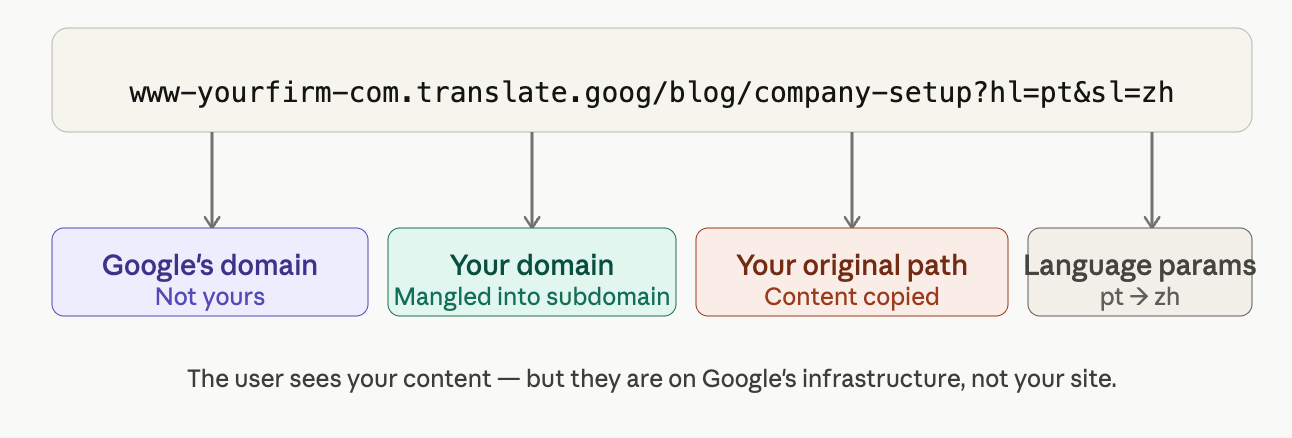
You may be generating genuine international interest right now. Your content may already be appearing in English search results. And you would have almost no way of knowing, because the traffic is going somewhere else. In short, Google is stealing it.
The AI Search Problem Is Making This More Urgent
There is another layer to this that is becoming harder to ignore.
You have probably noticed the AI summaries that now appear at the top of Google search results – a paragraph or two that answers the question directly, before you even scroll to the links. Google generates these from whatever content it considers most authoritative on the topic.
If your competitors have genuine English-language pages and you do not, they get cited in those summaries. You do not. Your potential client reads an AI-generated answer that references your competitor’s expertise, clicks through to their site, and never knows you existed.
Research published by Weglot in early 2026, based on an analysis of over 1.3 million of these AI citations, found that sites with properly translated pages received dramatically more citations in cross-language searches – in one market, the gap was as large as 327%. The full study: Does AI Favor Translated Content?
Four Reasons a Real English Presence Cannot Be Shortcut
Building genuine visibility in an English-speaking market requires more than getting your text into English. It requires building the whole context that tells Google, and international buyers, that you belong there.
1. English-speaking buyers search differently
The queries your potential clients type into Google in English are not translations of the queries your Mandarin-speaking clients use. The vocabulary is different, the way people frame their problems is different, and the questions they ask at each stage of the buying process are different.
Content that ranks in Mandarin was written to answer questions that Mandarin-speaking buyers ask. Auto-translated, it becomes English text that answers questions English-speaking buyers are not asking. It will not appear for the searches that matter, because it was never built around them.
2. Trust signals do not cross markets automatically
In professional services – law, accounting, finance, immigration – buyers assess credibility carefully before making contact. The signals they look for in your country are not the same ones that reassure a buyer in the US or UK. Credentials, affiliations, case study formats, and the way expertise is communicated all carry different weight in different markets.
An auto-translated page carries your existing trust signals, framed for a market that does not recognise them. Google, which uses trust signals as a major ranking factor for professional and financial content, treats the page accordingly.
3. The technical structure is still single-language
Search engines use a set of technical signals to understand which language and country each page is intended for. The most important of these are hreflang tags: code in the page that tells Google that this page is for English speakers in the US, and this other page covers the same content for Mandarin speakers in Taiwan.
Auto-translate does not add hreflang tags. It does not create separate URLs for different language versions. It does not resolve any of the structural questions that determine whether Google understands your site as a multilingual resource or a single-language one. Without this infrastructure, your English-language presence does not exist in the way that matters for search.
4. The content journey was built for someone else
A website that works well in one market reflects a deep understanding of how buyers in that market move from first awareness to making contact. The topics covered, the order they are introduced in, the internal links that lead a reader deeper – all of this was designed, consciously or not, for your existing audience.
An English-speaking buyer goes through a different journey. They start with different questions, carry different assumptions about your industry, and need different reassurances before they are ready to reach out. Auto-translate carries the original journey intact. It does not adapt it.
What You Can Do About It
If your content is currently being proxied and you want to act quickly, there are two options.
The more effective one is also the more valuable long-term: publish genuine English-language versions of your key pages, with the correct technical setup. When Google finds a real English page on your domain for a query, it typically stops showing the proxy version within days. The traffic starts coming to you.
The faster but more limited option is to add a tag to your pages that tells Google not to translate them. This stops the proxy, but it also means your pages will only appear for searches in your original language. You remove the problem, but you also remove any passive international visibility you were getting. For most businesses with international ambitions, this is a temporary measure at best.
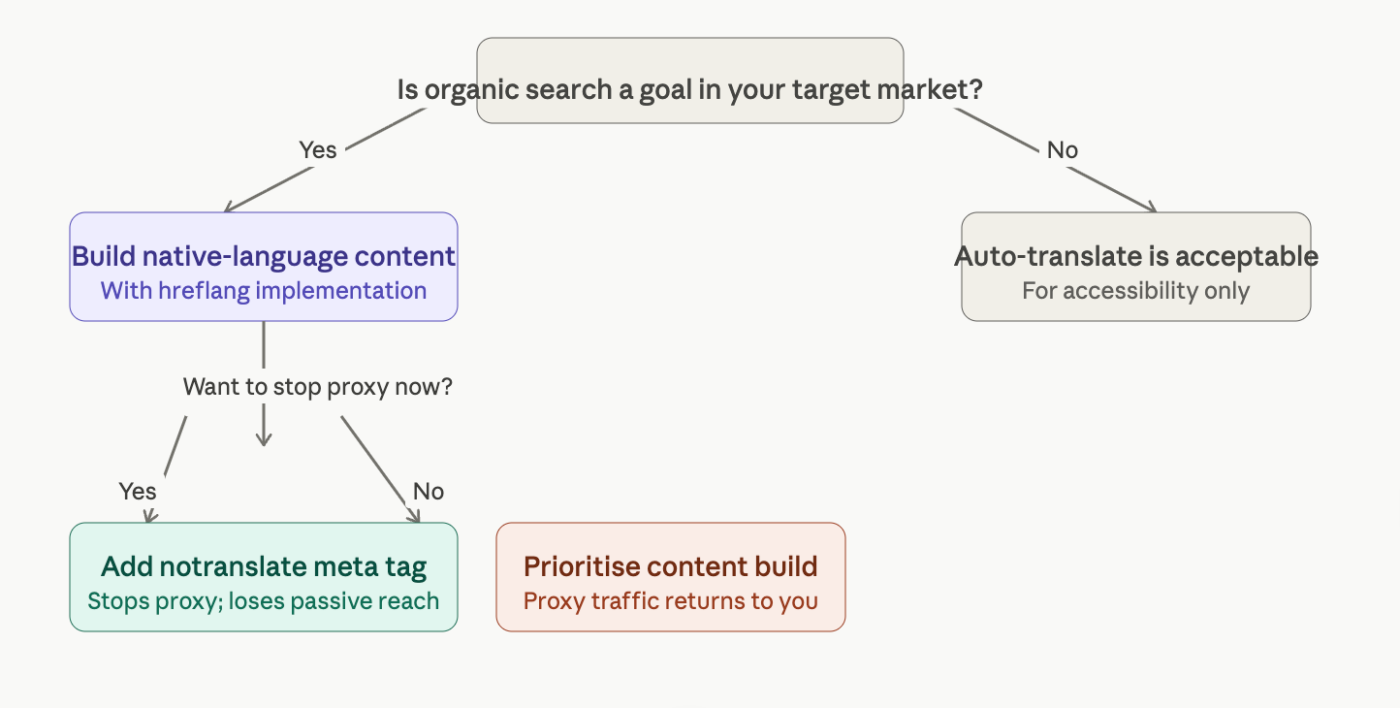
For businesses that are serious about entering English-speaking markets, the right starting point is an honest assessment of where you currently stand: what your site signals to Google about its intended audience, what English-speaking buyers in your sector are actually searching for, and what would need to be built to compete for that traffic.
That is exactly what BlazeLink covers. If you want a clear picture of your international growth potential, and a practical first 180-day roadmap, we are happy to walk through it with you.
Is Your Website Lost in Translation?
If you suspect your localized content is alienating global buyers rather than attracting them, it’s time to audit your cross-border framework.
Let our team at BlazeLink review your current multilingual setup, technical structure, and content journey to design a system optimized for global conversion.